


DHI or Sapphire FUE? Which Method Suits You?
Key takeaways
- DHI and Sapphire FUE harvest grafts in the same way, one by one with FUE; the difference lies in the channel opening and placement step.
- In DHI, the Choi pen opens the channel and places the graft in a single step; in Sapphire FUE, channels are opened with a sapphire-tipped blade and grafts are placed with forceps in a separate step.
- A preference for no shaving or implantation among existing hair may bring DHI into the discussion, while planning a wide area may bring Sapphire FUE; neither method is generally superior to the other.
- The choice of method is made through a doctor's assessment; results vary from person to person.
The difference between DHI and Sapphire FUE lies not in how grafts are harvested but in how channels are opened and grafts are placed in the recipient area: in DHI, the Choi implanter pen opens the channel and places the graft in a single step, while in Sapphire FUE the channels are opened with a sapphire-tipped blade and the grafts are placed with forceps in a separate step. Both methods share the same FUE foundation, in which grafts are taken one by one from the donor area.
That is why the question "DHI or sapphire?" has no single answer that applies to everyone. Which method is considered depends on whether you are willing to have your hair shaved, whether there is still hair in the area to be treated, how wide the bald area is and what capacity your donor area has. In this article we put the two methods side by side, explain the situations in which each may come into consideration and what stays the same in both.
If you would like to learn about each method in detail, see our articles What Is DHI Hair Transplant and Sapphire FUE versus Classic FUE. The information here is for general purposes only; the method suitable for you is determined by the doctor after an examination, and results vary from person to person.
Common ground: both methods are based on FUE
It is a common misconception to think of DHI and Sapphire FUE as two entirely different operations. In both methods, the procedure starts under local anaesthesia with grafts being taken one by one with micro punches from the donor area, usually the back of the head and the area above the ears. This stage is called FUE (Follicular Unit Extraction) and follows the same logic in both methods.
Graft harvesting, the tiny dot marks that form in the donor area and the preservation of donor capacity all depend on this shared stage. So the answer to "which one leaves fewer marks in the donor area?" depends less on the name of the method than on the number of grafts taken and how evenly they are distributed; we cover this separately in our article on hair transplant scarring. The methods differ in what happens in the recipient area after the grafts have been harvested.
The real difference: channel opening and placement
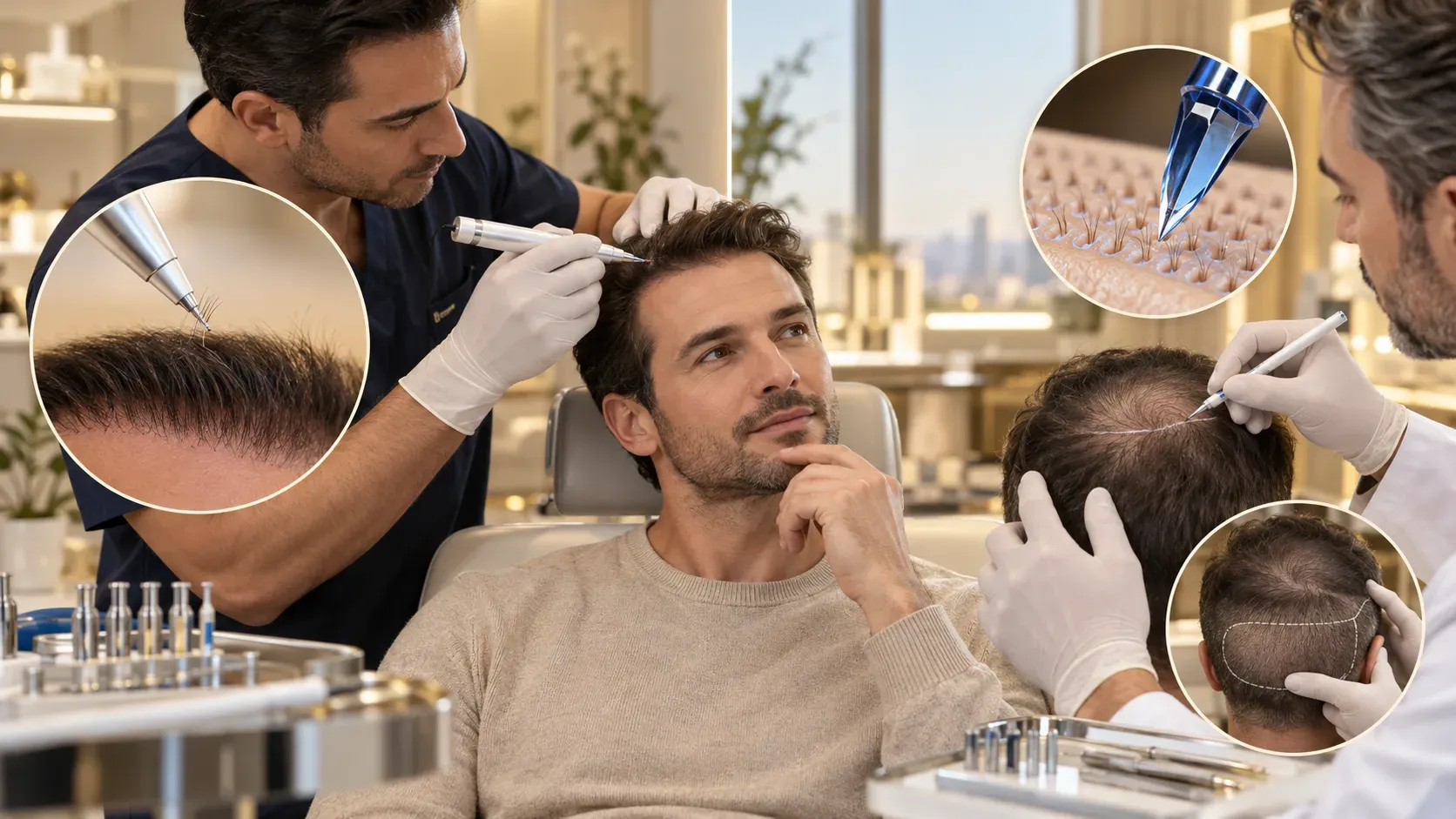
In Sapphire FUE, channels are first opened in the recipient area with sapphire-tipped blades; their direction, angle and distribution are set at this stage. The grafts are then placed one by one into the opened channels with fine tweezers called forceps. In other words, channel opening and placement are two separate steps.
In DHI, the grafts are loaded into the Choi implanter pen. As the tip of the pen enters the skin it opens the channel and places the graft in the same movement, so channel opening and placement are combined in a single step. Because the graft is carried inside the pen during placement, it is not held with forceps. The table below summarises only the factual differences; neither method is generally superior to the other.
The durations in the table are typical ranges; the actual duration depends on the planned number of grafts and the treatment area, and is communicated after the doctor's assessment.
| Feature | DHI | Sapphire FUE |
|---|---|---|
| Graft harvesting | One by one with FUE | One by one with FUE |
| Channel opening | With the Choi pen, in one step with placement | With a sapphire-tipped blade, in a separate step |
| Instruments used | Choi implanter pen | Sapphire-tipped blade and forceps |
| Graft placement | With the Choi pen (no-touch) | With forceps |
| Typical duration | 6-8 hours (single session) | 4-6 hours (single session) |
| Anaesthesia | Local anaesthesia | Local anaesthesia |
| Shaving | Can be performed without shaving in some areas | Usually required |
| When it may be considered | Implantation among existing hair, narrow donor area strategies, preference for no shaving | Plans in which a fine channel structure is the aim |
When may DHI be considered?
The single-step placement of DHI may be given priority by the doctor under certain planning conditions. The situations below are not fixed rules but topics that frequently come up during the assessment.
We explain how DHI works and who it is considered for step by step in our article What Is DHI Hair Transplant.
- Preference for no shaving: for candidates who do not want their hair cut short, DHI may be considered as an option that can be performed without shaving in some areas; whether this is possible depends on the size of the treatment area.
- Implantation among existing hair: in an area that has thinned but is not completely bald, where grafts need to be placed between existing hairs without damaging them, the pen's controlled implantation angle can support the plan.
- Dense placement: in limited areas such as the hairline, where dense and natural distribution matters, DHI may be preferred.
- Narrow donor area strategies: where donor capacity is limited and the grafts are planned to be concentrated in a specific area, DHI may come into consideration.
When may Sapphire FUE be considered?
Because channels are opened in a separate step in Sapphire FUE, the implantation map can be laid out across the entire recipient area in advance. Once the channels are opened, the grafts are placed according to this map.
We discuss in detail how the sapphire tip differs from the classic steel tip in our article Sapphire FUE: How It Differs from Classic FUE.
- Wide area: in plans where the bald area is extensive, covering both the front and the crown, Sapphire FUE may be considered.
- Fine channel structure: since a fine channel structure is the aim with sapphire-tipped blades, it may be preferred in plans where this goal is a priority.
- When shaving is not an issue: Sapphire FUE usually requires shaving; for candidates who do not mind having their hair cut short, this is not a constraint.
- Session planning: the typical duration of Sapphire FUE is 4 to 6 hours and that of DHI 6 to 8 hours; duration alone is not a selection criterion and is assessed together with the planned number of grafts.
What does not change between the two methods
What is most often overlooked when comparing methods is that many of the factors shaping the outcome are independent of the method. Whether DHI or Sapphire FUE is chosen, the following points remain the same.
This is why the name of the method matters less than the plan itself. Hairline design, graft distribution and protection of the donor area directly affect the outcome in both methods.
- Donor capacity: the number of grafts that can be taken does not increase with the method; it is limited by hair density at the back and sides of the head.
- Graft planning: how many grafts are needed is determined by the size of the bald area and the degree of hair loss; we explain this in our article on graft planning and the Norwood scale.
- Anaesthesia: both methods are performed under local anaesthesia in a single session.
- Recovery timeline: temporary shedding, new growth becoming visible around months 3 to 4 and a process that is largely complete around month 12 follow a similar course in both methods.
- Aftercare rules: washing, protection and follow-up steps after the procedure are the same.
Combining both techniques: Max Hair Transplant and Ice Cell
In some plans the question is no longer "DHI or sapphire?". Max Hair Transplant, our clinic's signature protocol, combines sapphire channel opening and DHI placement on an FUE foundation. Planning is individualised and the entire process is carried out under doctor supervision. You can find the details of the protocol in our article on the Max Hair Transplant method.
Ice Cell Sapphire FUE, meanwhile, uses sapphire-tipped instruments for channel opening and is built around keeping the harvested grafts in a cold cell environment throughout the procedure. We describe this approach separately in our article on Ice Cell Sapphire FUE. These options are not suitable for everyone either; which one is considered is again determined after an examination.
How is the decision made?
The right starting point is not choosing a method name but clarifying your own situation. Coming to the planning consultation with answers to these questions makes the assessment easier: Are you willing to have your hair shaved? Is there still hair in the area to be treated? Is the bald area limited to the front, or does it also include the crown? Have you had a hair transplant before?
After examining your donor area, hair loss pattern and expectations, the doctor explains whether DHI, Sapphire FUE or a protocol combining both techniques fits your plan. You can start this process remotely by sharing your photos for an online pre-assessment. Results vary from person to person.
Frequently asked questions
Related treatments
Related pages
This article is for general information only and is not a diagnosis or a treatment recommendation. Suitability is determined by a doctor's assessment; results vary from person to person.