


What Is a Hair Transplant? Guide to Methods, Process and Preparation
Key takeaways
- A hair transplant moves grafts taken from the donor area to the thinning area under doctor supervision.
- Classic FUE, DHI and Sapphire FUE share the same harvesting basis; the difference lies in channel creation and placement.
- Method choice and suitability are determined by doctor assessment; results vary from person to person.
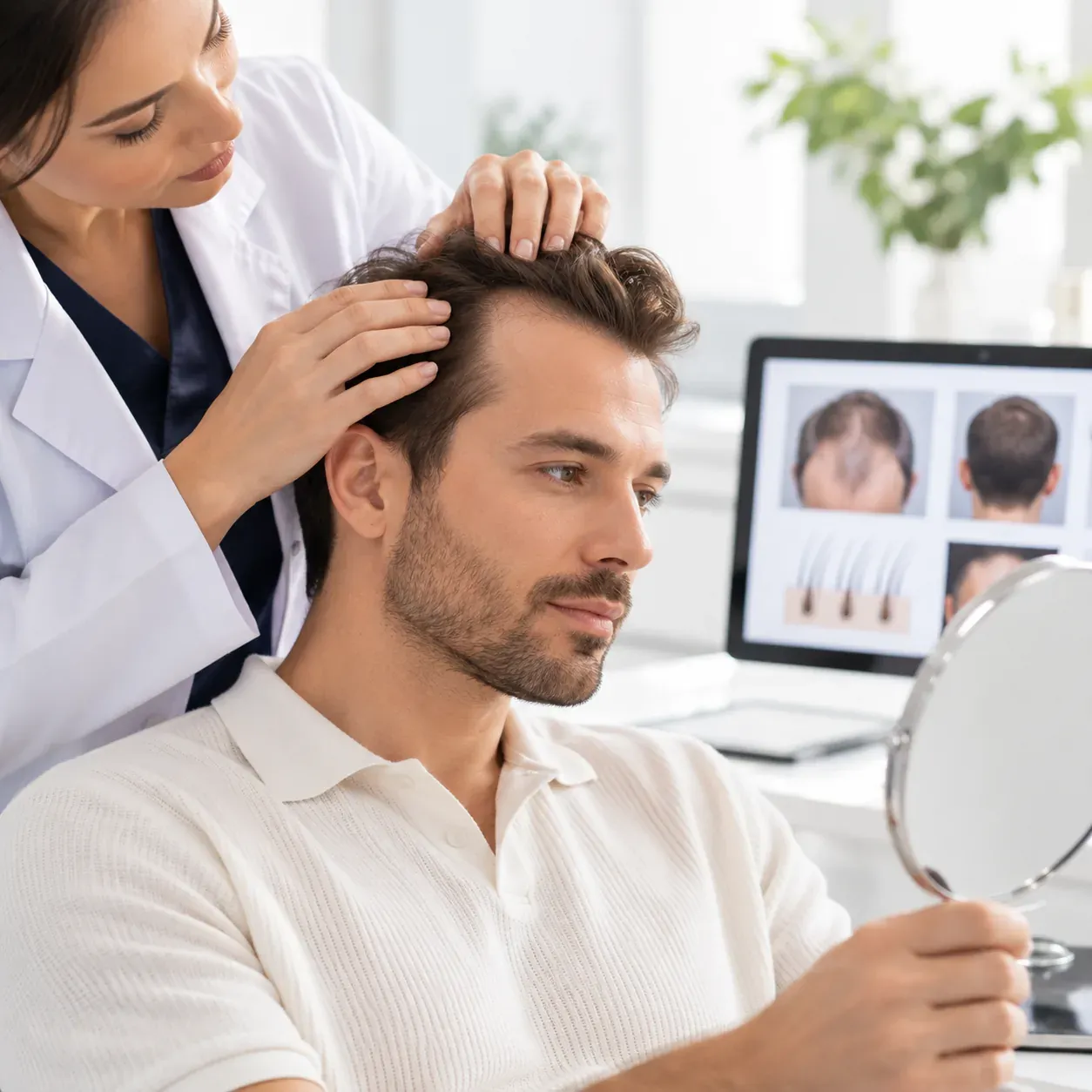
A hair transplant is a surgical procedure in which hair follicles taken from the loss-resistant donor area of the scalp (usually the back and sides) are moved to a thinning or bald area. Each transplanted unit is called a graft; a graft is a cluster of roots containing one to four hairs. The procedure is planned under local anaesthesia, under doctor supervision and in most cases in a single session.
At Max Hair, a hair transplant is planned individually through a doctor's assessment of the hairline, donor area, loss pattern and expectations. This guide brings together the Classic FUE, DHI and Sapphire FUE methods, the steps of the procedure day, preparation advice and the healing timeline.
The information here is general in nature; it does not replace a diagnosis or medical advice. The method and plan suitable for you are determined by the doctor after an examination and assessment.
Who is a hair transplant considered for?
A hair transplant is usually considered for people who experience thinning in specific areas due to male or female pattern hair loss and who have a sufficient donor area. Candidacy is not decided by a formula but by the doctor examining the scalp, the donor area and the loss pattern.
Four points stand out in the assessment, and each directly affects the planned graft distribution and the method to be preferred.
- Donor area: The hair density at the back and sides determines how many grafts can be harvested safely.
- Loss pattern: Where the loss is located and whether it is still progressing shapes the hairline design.
- General health: Chronic conditions, medications in use and the condition of the scalp are reviewed by the doctor.
- Expectations: The intended appearance is planned realistically together with the available donor capacity.
How do Classic FUE, DHI and Sapphire FUE differ?
All three methods use the FUE (Follicular Unit Extraction) basis to harvest grafts one by one from the donor area. The difference appears in how the channels are created and how the grafts are placed.
In Classic FUE, channels are created with a steel slit tip in a separate step and grafts are placed with forceps. In DHI, the Choi implanter pen creates the channel and places the graft in one step. In Sapphire FUE, channels are created with a sapphire tipped blade and placement takes place with forceps in a separate step.
The table below summarises only the factual differences; no method is generally superior to another. Which method suits you is determined by a doctor's assessment.
| Feature | Classic FUE | DHI | Sapphire FUE |
|---|---|---|---|
| Channel creation | Steel slit tip, as a separate step | Choi pen, in one step with placement | Sapphire tipped blade, as a separate step |
| Instrument | Steel slit tip and forceps | Choi implanter pen | Sapphire tipped blade and forceps |
| Graft placement | With forceps | With the Choi pen (no-touch) | With forceps |
| Typical duration | 6-8 hours (single session) | 6-8 hours (single session) | 4-6 hours (single session) |
| Anaesthesia | Local anaesthesia | Local anaesthesia | Local anaesthesia |
| Shaving requirement | Usually required | Can be applied unshaven (regional) | Usually required |
| When it is considered | Standard cases where the traditional FUE protocol is deemed sufficient | Implanting among existing hair, narrow donor area strategies, unshaven preference | Plans where a fine channel structure is aimed for |
How does the procedure day unfold?
The procedure day begins with the doctor's final assessment and the drawing of the hairline; the area is then prepared and local anaesthesia is applied. The duration varies with the method and the planned area but is generally between 4 and 8 hours, and you are discharged the same day.
The steps below show the common framework for Classic FUE, DHI and Sapphire FUE; the channel creation and placement step differs by method.
- Doctor assessment and hairline design: The recipient and donor areas are marked and the plan is clarified together with you.
- Area preparation and local anaesthesia: Shaving is done if required; the donor and recipient areas are numbed with local anaesthesia.
- Graft harvesting: Grafts are taken one by one from the donor area with FUE and kept under suitable conditions until placement.
- Channel creation: A steel slit tip is used in Classic FUE and a sapphire tipped blade in Sapphire FUE; in DHI this step merges with placement.
- Graft placement: Grafts are placed with forceps or the Choi pen, respecting the natural direction and angle.
- Care guidance and discharge: The washing, protection and follow-up schedule is shared; you are discharged the same day.
How do you prepare before the procedure?
Preparation starts weeks before the procedure with an online assessment: your photos are shared via WhatsApp or the online form, and your loss pattern and donor area are routed for doctor assessment. The method, hairline and expectations are then discussed in the planning consultation.
The advice below is general information. Your personal instructions are given by the doctor based on your health history and always take priority.
- Report all medications, supplements and chronic conditions fully during the planning consultation.
- If you use blood-thinning medication or supplements, decide on any pause only together with your doctor.
- Your doctor may ask you to avoid smoking and alcohol for a certain period before the procedure; ask your doctor about the duration.
- Complete the pre-procedure checks requested by the doctor and bring the results with you.
- On the procedure day, wear comfortable clothing that opens at the front and does not need to be pulled over your head.
- If you are travelling from outside Türkiye, finalise your travel plan in advance, including accommodation, transport and follow-up appointments.
How does the healing process progress?
Healing is a gradual process that starts the day after the procedure and extends over months. Mild swelling, redness and crusting may occur in the first days; these are part of natural healing and are followed with the doctor's care advice.
Shedding of some transplanted hairs in the first weeks (shock loss) is an expected stage. New growth usually becomes visible around months 3 to 4 and the process is largely complete around month 12. Results vary from person to person.
- Days 1 to 10: Mild swelling and redness may occur; do not scratch or touch the scalp.
- First week: Heavy exercise and strenuous activity are avoided.
- First two weeks: The scalp is protected from direct sunlight.
- First weeks: Temporary shedding (shock loss) may occur; this is an expected stage.
- Months 3 to 4: New hair growth becomes visible.
- Month 12: The process is largely complete; follow-up continues with check-up appointments.
Who may a hair transplant not be suitable for, and what are the possible side effects?
A hair transplant is not suitable for everyone. For people with an insufficient donor area, those whose loss is not yet stable and is progressing widely, those with an active infection or inflammatory condition of the scalp, and those with an uncontrolled chronic disease, the doctor may recommend a different approach.
Like any surgical procedure, a hair transplant has possible side effects: temporary swelling, redness, crusting, tenderness, a feeling of numbness, temporary shedding and, rarely, infection or inflammation of the hair follicles (folliculitis). Most of these effects are temporary; they are followed through adherence to care instructions and check-up appointments.
This section does not replace an individual risk assessment. Possible risks are explained by the doctor before the procedure according to your health status, and your consent is obtained.
How is the hair transplant process planned in Türkiye?
For clients coming from outside Türkiye, the process starts remotely with an online assessment and a planning consultation; your trip to Istanbul for the procedure day is planned around the check-up and care steps recommended by the doctor. Post-procedure washing and care guidance continues to be shared step by step by our team after you return home.
Our health tourism page guides travel and accommodation planning, while the Classic Hair Transplant, DHI Hair Transplant and Sapphire Hair Transplant service pages give the method details.
Frequently asked questions
Related treatments
Related pages
This article is for general information only and is not a diagnosis or a treatment recommendation. Suitability is determined by a doctor's assessment; results vary from person to person.