


Hair Transplant in Women: Process, Methods and Differences from Men
Key takeaways
- Female pattern thinning usually appears as diffuse thinning over the crown and midline while the front hairline is preserved, so the transplant plan is built differently than for men.
- Before deciding on a hair transplant in women, the cause of hair loss is investigated through a doctor's assessment; a transplant is not a suitable option for every type of thinning.
- Hair transplant in women can often be planned with the no-shave DHI technique, and this approach can allow existing long hair to be preserved.
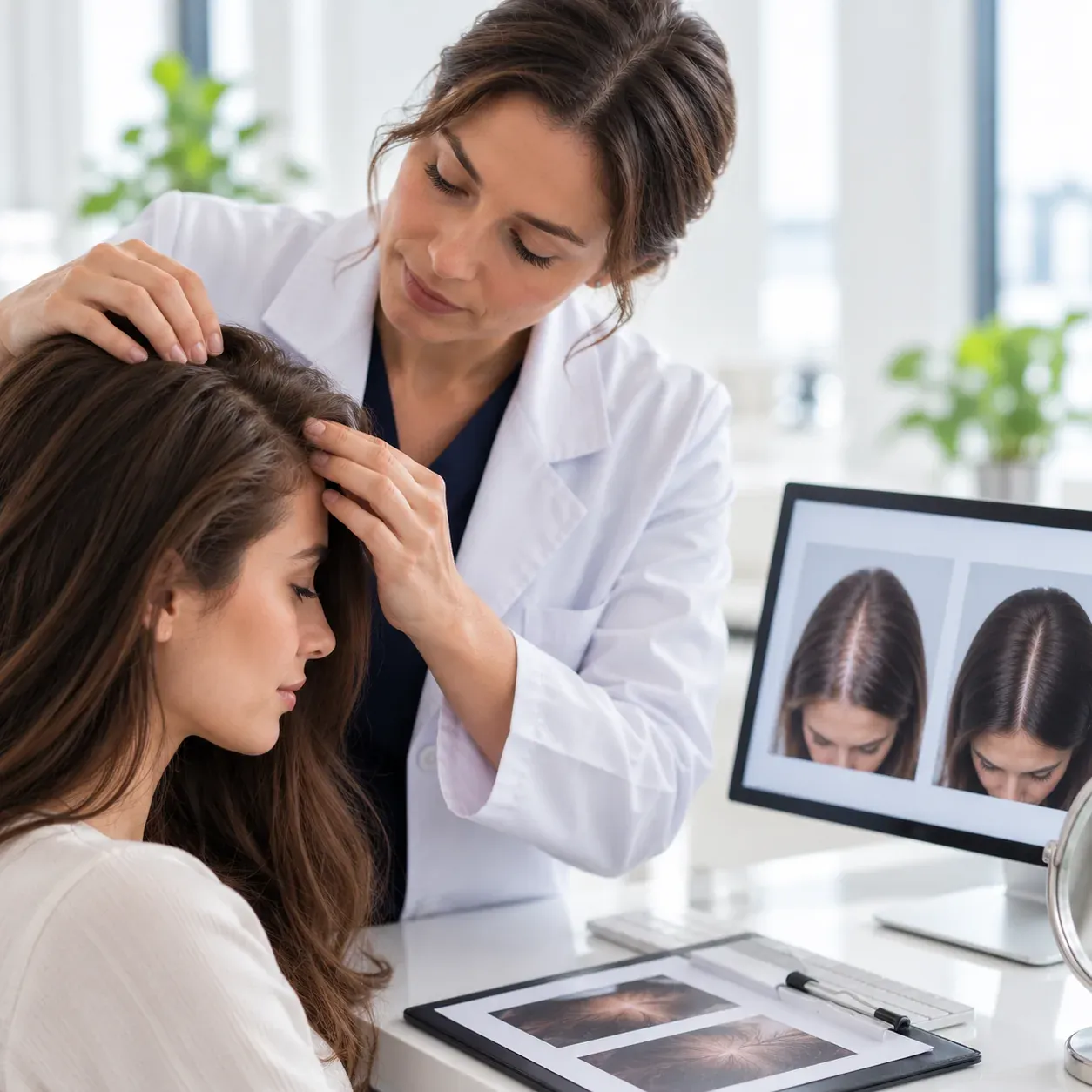
Hair transplant in women is a surgical hair restoration procedure for female pattern thinning in which grafts taken from the donor area are placed into thinning regions. It is usually performed under local anaesthesia and can often be planned with the no-shave DHI technique. The decision to transplant is made after the doctor has assessed the cause of hair loss and the condition of the donor area.
At Max Hair, hair transplant in women is planned under doctor supervision at our clinic in Istanbul, Türkiye. Planning considers the type of thinning, the hairline, donor area density and personal expectations together. Results vary from person to person.
How does female pattern thinning differ from male pattern hair loss?
Male pattern hair loss usually progresses as a receding frontal hairline and opening at the crown, and it is often classified with the Norwood scale. In female pattern thinning, the front hairline is usually preserved and thinning appears diffusely over the crown and midline. Different scales, such as the Ludwig classification, are used for this pattern.
A common sign in women is a parting line that gradually widens. Because the thinning is diffuse, the aim of the transplant is usually not to cover a bare area but to add density among existing hair.
The table below summarises typical planning differences between the two groups; it contains no superiority or outcome claims. The individual situation is always determined by a doctor's examination.
| Topic | Male pattern hair loss | Female pattern thinning |
|---|---|---|
| Typical appearance | Receding frontal hairline, opening at the crown | Front hairline usually preserved, diffuse thinning over the crown and midline |
| Common classification | Norwood scale | Ludwig classification |
| Aim of the transplant | Usually planning of bare areas and hairline design | Usually adding density among existing hair |
| Donor area | The back and sides are often less affected by hair loss | Diffuse thinning may also affect the donor area; density is assessed separately |
| Investigation of the cause | Assessed through a doctor's examination | Hormonal and general health causes are also investigated; blood tests may be requested |
| Shaving approach | Planned with or without shaving depending on the case | No-shave DHI may often be preferred |
| Typical procedure duration | 6-8 hours (single session) | 4-6 hours (single session) |
Why is the cause of hair loss investigated before deciding on a transplant?
Hair loss in women has no single cause; hormonal changes, thyroid problems, iron deficiency, the postpartum period, intense stress and certain medications may accompany it. In some of these cases the hair loss may be temporary, and the cause may need to be addressed first instead of a transplant. For this reason, the doctor assesses the type of hair loss and its possible causes before any transplant plan.
The assessment usually covers the following points:
- Medical history: information such as chronic conditions, medications in use, pregnancy and the postpartum period is shared with the doctor.
- Blood tests: when the doctor considers it necessary, tests such as thyroid values and iron stores may be requested.
- Scalp examination: the distribution of thinning, the parting line and the condition of the scalp are examined.
- Donor area assessment: whether the density at the back and sides is suitable for graft harvesting is checked.
- Expectations: the desired appearance is discussed realistically together with the donor capacity.
Who may a hair transplant not be suitable for in women, and what are the possible side effects?
A transplant is not a suitable option for every type of thinning. In diffuse thinning where the donor area has also become noticeably thinner, the number of grafts that can be harvested may be limited, so the doctor may recommend a different approach.
The procedure may be postponed or not recommended in cases of active hair loss whose cause is not yet clear, an active scalp condition, scarring types of hair loss, uncontrolled chronic illness or bleeding disorders. Pregnancy and breastfeeding are also among the situations that should be shared with the doctor before planning.
Possible side effects are similar to other hair transplant procedures: swelling, redness, crusting, temporary numbness and tenderness may occur in the recipient and donor areas. Temporary shedding of the implanted hair and of the surrounding existing hair may occur in the first weeks; folliculitis or infection may rarely develop, and these are assessed by the doctor at follow-up appointments.
How is no-shave planning done, and where does DHI fit in?
A no-shave approach may often be preferred for hair transplant in women; this approach can allow existing long hair to be preserved. Whether no-shave planning is suitable is determined by the doctor according to hair structure, the size of the planned area and donor area density.
In DHI, the Choi implanter pen opens the channel and releases the graft in the same movement; the direction, angle and depth of each graft are controlled with the pen. This feature gives the doctor planning flexibility when grafts need to be placed among existing hair in thinning areas. DHI is not superior to other methods on its own; the choice of method depends on the doctor's assessment.
A small area in the donor zone may need to be shortened for graft harvesting; with long hair, this area can often be covered by the hair above it. The shaving plan is decided together with the doctor, taking hair length and the size of the recipient area into account.
How are privacy and the return to daily life planned?
For many women, going through the process without it being noticed by others is an important priority. No-shave planning can be a practical option in this respect; however, it should be kept in mind that redness and small crusts may be visible in the recipient area during the first days.
Discussing the timing of your return to work and social life with the doctor during the planning consultation makes it easier to set a realistic schedule for the first weeks. When you can return to wearing tight hats or head coverings, hair colouring and styling products is determined by the doctor's instructions.
In Türkiye, health data is classed as a special category of personal data under Personal Data Protection Law No. 6698. You can state your preferences regarding photographs and their use during the planning consultation.
How does the procedure day progress for women?
Hair transplant in women is usually performed under local anaesthesia in a single session and typically takes 4-6 hours. The duration may vary with the size of the planned area and the pace of graft harvesting. The procedure follows these steps:
- Doctor examination and planning of the hairline and thinning areas.
- Application of local anaesthesia and preparation of the donor area (often without shaving).
- Extraction of grafts one by one and their placement into the thinning area with DHI.
- Post-procedure briefing and scheduling of follow-up appointments.
How do recovery and follow-up progress?
Crusting in the recipient area during the first days is an expected phase, and the first wash is done under the doctor's guidance. In the early period, sun protection, avoiding strenuous exercise and not touching the recipient area are recommended.
New hair grows gradually over months, and the final assessment is usually made towards the end of the first year. The process is monitored by the doctor at follow-up appointments; supportive applications may be planned if considered necessary.
Frequently asked questions
Related treatments
Related pages
This article is for general information only and is not a diagnosis or a treatment recommendation. Suitability is determined by a doctor's assessment; results vary from person to person.