


What Is a Classic FUE Hair Transplant? The Procedure Step by Step
Key takeaways
- Classic FUE is the standard hair transplant technique in which grafts are extracted one by one from the donor area with micromotor punches, channels are opened with a steel slit and grafts are placed with forceps.
- The procedure is performed under local anaesthesia, in most cases in a single session of 6 to 8 hours, and you are discharged the same day.
- FUE involves no incision or stitches; instead of the linear scar of the older FUT method, tiny millimetre-scale dot marks form.
- Sapphire FUE and DHI share the same graft extraction basis; the suitable method is determined by a doctor’s assessment, and results vary from person to person.
A classic FUE hair transplant is the standard technique in which hair follicles are extracted one by one from the donor area at the back of the head and above the ears using fine micromotor punches, then placed with forceps into channels opened with a steel slit. FUE stands for Follicular Unit Extraction. The procedure is planned under local anaesthesia, under a doctor’s supervision and, in most cases, in a single session lasting 6 to 8 hours.
In this article we explain what classic FUE is, how the procedure day unfolds step by step, how it differs from the older FUT method, who it is evaluated for and what the recovery timeline looks like. We also cover how methods such as Sapphire FUE and DHI relate to classic FUE. This article is for general information; suitability is determined by a doctor’s assessment and results vary from person to person.
What is classic FUE and what is a follicular unit?
Hairs do not grow individually beneath the skin but in natural groups of one to four hairs. These groups are called follicular units, and each unit transferred in a hair transplant is called a graft. The core idea of FUE is to extract these natural units one by one from the donor area without breaking them apart.
Classic FUE is the simplest and most widely used form of this extraction technique. Once the grafts are harvested, channels are opened in the recipient area with a steel slit and the grafts are placed into these channels with forceps. Channel opening and placement are carried out as two separate steps. At Max Hair, the classic hair transplant is the foundational protocol, planned for standard cases after a doctor’s assessment.
The back of the head and the area above the ears are usually chosen as the donor area, because follicles there are generally more resistant to shedding. How many grafts can be taken depends on the density and capacity of the donor area; we explained how this is calculated in our graft planning article.
How does the classic FUE procedure day unfold, step by step?
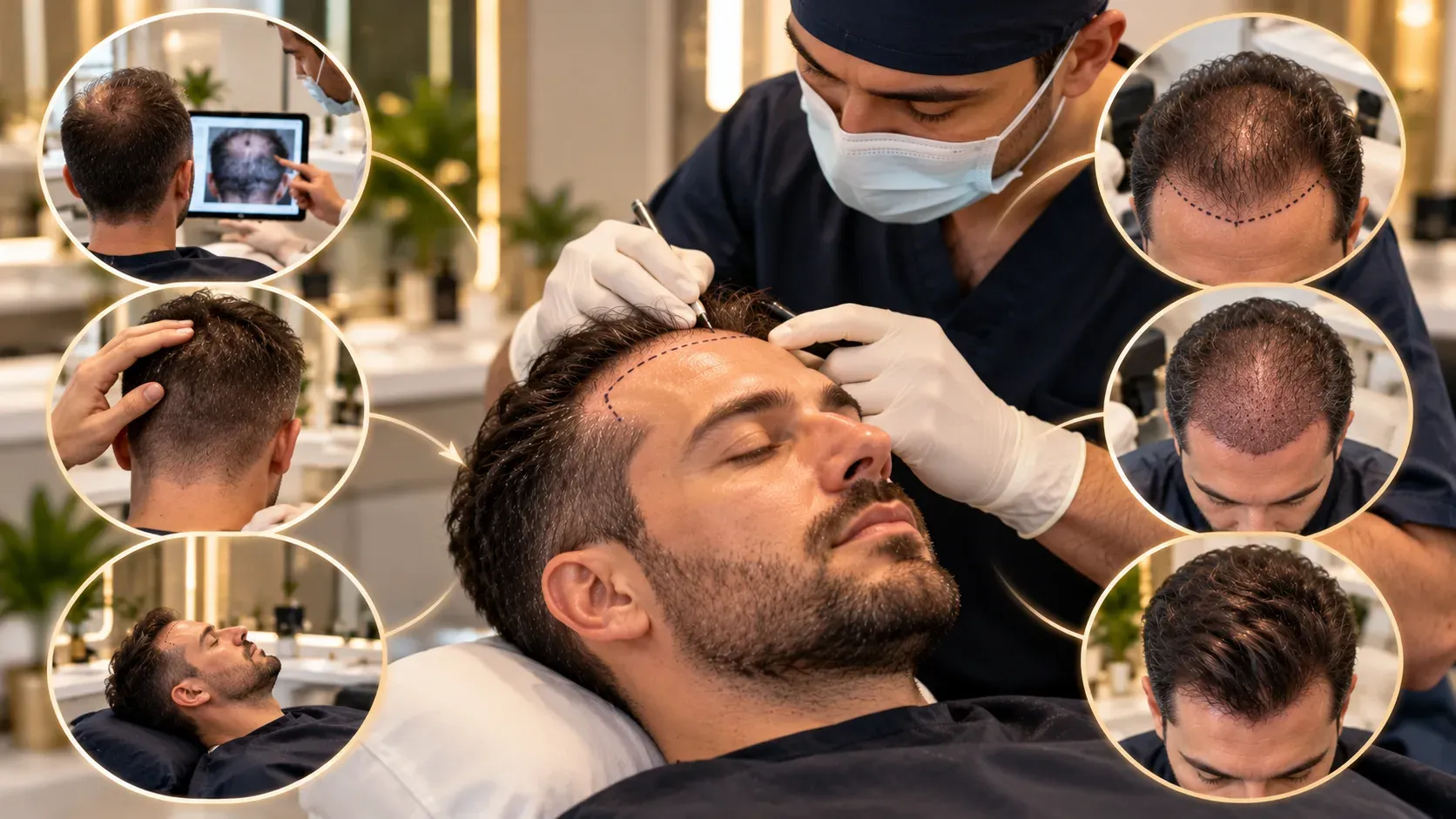
The procedure day follows a set sequence. The steps below show the general flow of classic FUE; the duration of each step depends on the planned number of grafts and the size of the recipient area. Because it is a long procedure, short breaks are taken during the day; we covered comfort during the procedure in detail in our anaesthesia and comfort article.
- Examination and final assessment: the doctor examines the scalp, the donor area and the hair loss pattern, and reviews your medical history and current medication.
- Hairline design: the front hairline is drawn to suit your facial proportions and age, the recipient area is marked and the plan is finalised together with you.
- Shaving and preparation: the donor area is trimmed short so grafts can be extracted easily; the recipient area is prepared according to the plan and both areas are cleaned.
- Local anaesthesia: the donor area is numbed first with local anaesthesia; a brief, mild sensation may be felt during the injections, after which the procedure continues while you remain awake.
- Graft extraction: follicular units are removed one by one from the donor area with fine circular punches attached to a micromotor.
- Graft storage: the harvested grafts are counted, sorted and kept in a suitable storage solution under controlled conditions until they are placed.
- Channel opening: once the recipient area is numbed, channels are opened with a steel slit, following the natural direction and angle of the hair.
- Graft placement: the grafts are placed into the channels one by one with forceps; single-hair grafts are usually used along the front hairline and multi-hair grafts further back.
- Dressing and discharge: a dressing is applied to the donor area, care and washing instructions and the follow-up schedule are shared, and you are discharged the same day.
What happens during graft extraction and channel opening?
Graft extraction is the most labour-intensive stage of classic FUE. Micromotor punches are usually 0.7 to 0.9 millimetres in diameter; the punch makes a circular incision around the follicle and the graft is gently lifted out with a fine instrument. The angle, depth and speed of the punch are constantly controlled so that the follicle is not damaged.
Grafts are taken with an even distribution across the donor area; no single spot is harvested densely. This approach aims both to preserve the natural look of the donor area and to keep a reserve of grafts that may be needed later. We explained how dot marks form in our article on whether a hair transplant leaves scars.
In classic FUE, a steel slit is used to open the channels. The direction, angle and density of the channels directly determine how the transplanted hair will look once it grows. That is why this stage is not just a technical step but also an aesthetic plan. During placement, the grafts are inserted into the channels with forceps without crushing the follicle.
How does FUE differ from the older FUT (strip) method?
Before FUE became widespread, the FUT method was used. In FUT, a strip of scalp is cut out from the back of the head, the area is stitched and the grafts are separated from the strip under a microscope. FUE involves no incision or stitches; the grafts are taken directly, one by one.
The table below summarises the factual differences between the two approaches. The hair transplant methods performed at our clinic are FUE based.
| Feature | FUE | FUT (strip) |
|---|---|---|
| How grafts are taken | One by one, with micromotor punches | A strip of scalp is cut out |
| Stitches | None | Yes |
| Donor-area mark | Scattered, millimetre-scale dot marks | A horizontal linear scar |
| Appearance with short hair | Usually concealed at a length of about 1 cm or more | The linear scar can show with short hair |
| Donor-area healing | Surface healing usually 3 to 7 days | Suture healing and stitch removal are required |
Who is classic FUE evaluated for?
Classic FUE is generally evaluated for people with thinning at the front, the crown or the hairline due to male pattern hair loss who have a sufficient donor area. It is planned as the foundational protocol in standard cases; the decision on candidacy is made by the doctor after an examination.
The assessment considers donor-area density, the stage and pace of hair loss, hair shaft thickness and overall health together. For people whose hair loss has not yet stabilised, who have an active scalp infection or whose donor area is insufficient, the doctor may recommend a different approach. Because the hair loss pattern differs in women, the assessment differs as well; we covered this in our article on hair transplants for women.
Recovery timeline after classic FUE
Recovery is a gradual process that starts the day after the procedure and extends over months. The timeline below gives a general framework; your personal care instructions come from the doctor and always take priority. We described the day-by-day care steps in detail in our post-transplant care article.
- First days: mild swelling, redness and tenderness may appear in the recipient and donor areas; the scalp should not be scratched or touched.
- First wash: its timing and method are set by the doctor, and the washing instructions are followed exactly.
- Donor area: surface healing is usually complete within 3 to 7 days.
- First two weeks: the crusts in the recipient area gradually fall away; the scalp is protected from direct sunlight.
- First weeks: temporary shedding of some of the transplanted hairs (shock loss) is an expected stage.
- Months 3 to 4: new hair growth begins to become visible.
- Around month 12: the process is largely complete; follow-up continues with check-up appointments.
How does classic FUE relate to Sapphire FUE and DHI?
Classic FUE, Sapphire FUE and DHI share the same graft extraction basis: in all three methods, grafts are taken one by one from the donor area. The difference lies in how the channels are opened and how the grafts are placed.
In Sapphire FUE, channels are opened with a sapphire-tipped blade instead of a steel slit, and placement is still done with forceps as a separate step. In DHI, the Choi implanter pen combines channel opening and placement into a single step. We examined the differences between Sapphire FUE and classic FUE in our Sapphire FUE article, and who DHI is evaluated for in our DHI hair transplant article.
None of these methods is generally superior to the others. The suitable method is determined by the doctor, taking the donor area, recipient area, hair characteristics and expectations into account together. If you are undecided between two methods, our DHI or Sapphire FUE article can also help.
What is the right next step with classic FUE?
Classic FUE is a straightforward, well-established hair transplant technique in which grafts are taken one by one, channels are opened with a steel slit and grafts are placed with forceps. The way to find out whether it suits you is to assess your donor area, hair loss pattern and expectations together with a doctor. You can start with a preliminary assessment based on your photos, followed by a planning consultation. Results vary from person to person.
Frequently asked questions
Related treatments
Related pages
This article is for general information only and is not a diagnosis or a treatment recommendation. Suitability is determined by a doctor's assessment; results vary from person to person.