


Hair Transplant, Hair System or Supportive Treatment? A Comparison Guide
Key takeaways
- A hair transplant is a surgical procedure in which a person's own hair follicles are taken from the donor area and implanted; cosmetic hair systems and supportive hair care applications are non-surgical.
- None of the three approaches is superior to the others; some options, such as a hair transplant and supportive applications, can be considered together within the same plan.
- Which path is suitable is determined by the doctor's assessment, taking the donor area, hair loss pattern, lifestyle and expectations into account together.
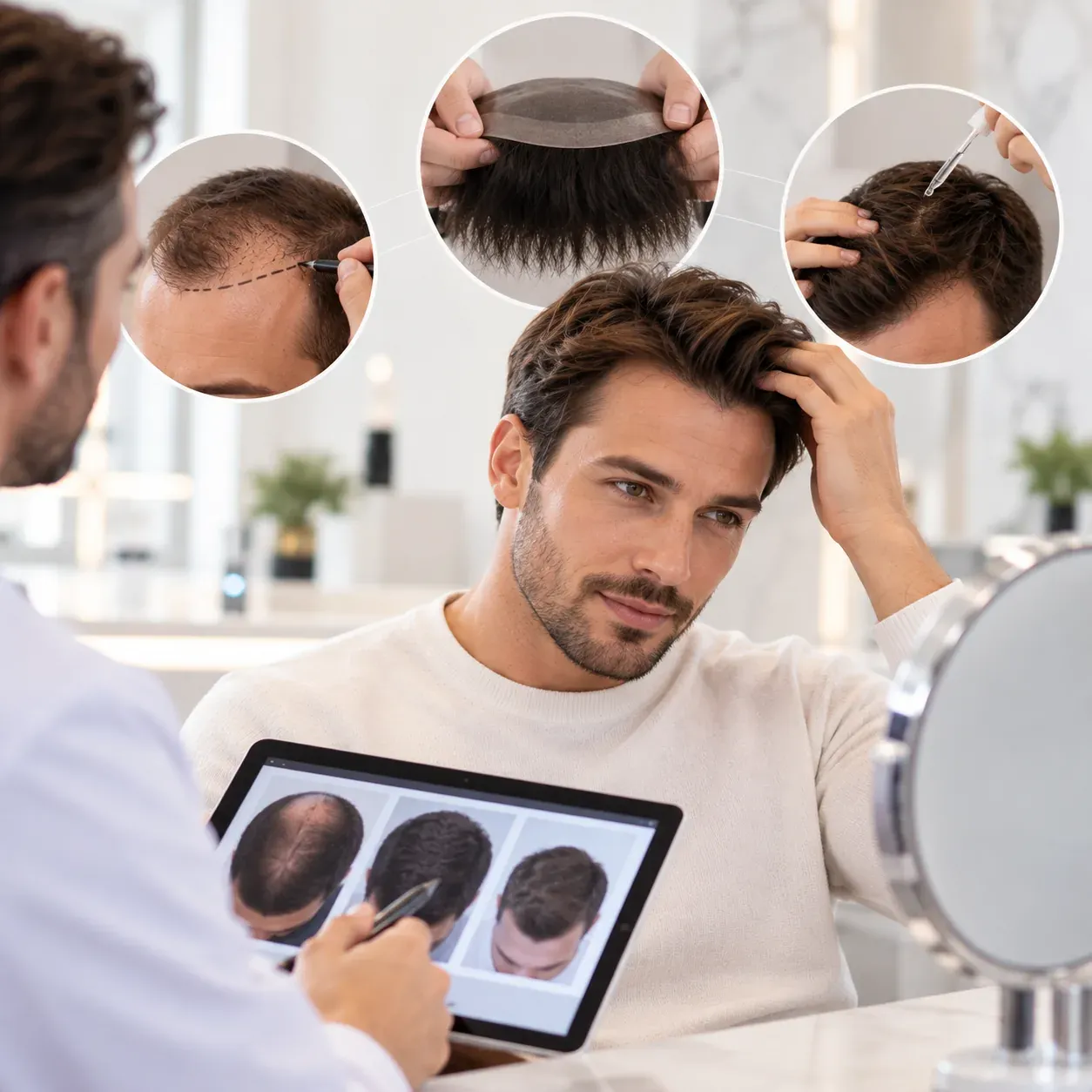
A hair transplant is a surgical procedure performed under local anaesthesia, in which a person's own hair follicles are taken one by one from the donor area and placed in thinning areas. Cosmetic hair systems are non-surgical hairpieces custom made on a thin base, while supportive hair care applications are non-surgical, session-based procedures aimed at supporting the scalp. None is superior to the others; the choice is made through the doctor's assessment of each person's situation.
At Max Hair, all three approaches are planned at our clinic in Istanbul, Türkiye, under the supervision of a doctor or the relevant specialist. This guide summarises the factual differences that can help with the decision and does not replace a diagnosis. Results vary from person to person.
What is a hair transplant and how is it performed?
A hair transplant is an FUE-based surgical procedure: grafts are extracted one by one from the donor area with micro motor tips and placed in the recipient area. Methods such as Classic FUE, DHI, Sapphire FUE and Max Hair Transplant differ in their channel opening and placement steps.
The procedure is performed under local anaesthesia, in a single session in most cases, and takes about 4-8 hours depending on the method. New hair growth usually becomes visible around months 3-4, and the process is largely complete around month 12.
What is a cosmetic hair system and what options are there?
A hair system is a custom cosmetic hairpiece made on a thin, breathable base. It involves no incision, suture or transplantation on the scalp; hair colour, texture and hairline are matched to blend with the existing hair.
The options differ by base and application characteristics. Celebrity's Choice is prepared on a fine lace base for on-camera and high-visibility scenarios, while Tres Pro is a custom system designed for everyday wear. Satin Lace is defined by its fine lace base, French Grip by its secure grip method and Dura by being prepared with durability and an active lifestyle in mind.
An application session usually takes 30-45 minutes and requires no anaesthesia; because of the measurement, matching and application steps, the process may extend over more than one appointment. The appearance changes on the day the system is applied, and regular care and follow-up appointments help maintain it.
What are supportive hair care applications?
Supportive applications are session-based procedures that involve no surgical incision and are aimed at supporting the scalp. Dr. Regrowth is one of the non-surgical applications in this group; it is planned following the doctor's assessment, compatible with the pre- and post-transplant process, and sessions usually last 30-45 minutes.
GFC Fibrin Plus is the application to the scalp of a growth factor concentrate obtained from the person's own blood; it is planned on the doctor's recommendation as a complementary protocol during the post-transplant recovery period, and sessions last 45-60 minutes. Applications such as Follicle Geni 360, Meso QR 678 and the Laser Helmet (LLLT) also belong to this category.
Unlike a hair transplant, these applications do not place new grafts; they are aimed at supporting the existing scalp. Any change may be observed over time, and the number of sessions is planned individually based on a scalp analysis.
How do a hair transplant, a hair system and supportive applications compare?
The table below compares the three approaches on factual characteristics only; it contains no outcome or superiority claims. Durations are a general framework and vary with the chosen method.
| Feature | Hair transplant | Cosmetic hair system | Supportive hair care |
|---|---|---|---|
| Surgical? | Yes; FUE-based surgical procedure | No; no incision, suture or transplantation | No; no surgical incision |
| Anaesthesia | Local anaesthesia | Not required | Not required, or topical when needed |
| Duration | Single session, about 4-8 hours depending on the method | 30-45 minute sessions; more than one appointment for measurement and matching | 30-60 minute sessions; session-based plan |
| Donor area | A sufficient donor area is required | Not required | Not required |
| Recovery | Swelling, redness and crusting may occur in the first 10 days; temporary shedding may occur in the first weeks | No surgical recovery period | No surgical recovery period; comfort level varies by application |
| When the appearance changes | New growth visible around months 3-4; process largely complete around month 12 | On the day of application | Over time; varies by application and person |
| Maintenance needs | Washing and care per the doctor's instructions in the first weeks; check-up appointments | Regular cleaning, care with suitable products and periodic check-ups | Planned session intervals and follow-up appointments |
| Who is it considered for? | People with a sufficient donor area, a hair loss pattern assessed by the doctor and a preference for a surgical procedure | People who prefer not to have surgery or who are looking for a quick and flexible change in appearance | People who wish to support the scalp or are looking for support before or after surgery |
| Supervision | Doctor supervision | Specialist supervision | Doctor or specialist supervision |
How do you decide which option is suitable?
The decision starts from an individual assessment, not from the name of a method. The assessment consultation usually considers the points below together; none is decisive on its own, and the final decision is made with you, based on the assessment of the doctor or relevant specialist:
- Donor capacity: in a hair transplant, the number of grafts that can be harvested depends on the condition of the donor area.
- Hair loss pattern: where hair loss is not yet stable, the doctor may postpone a transplant or suggest a different approach.
- View on surgery: for people who prefer not to have surgery, a hair system or supportive applications can be considered.
- Time expectations: with a hair transplant the appearance develops gradually over months, whereas with a hair system it changes on the day of application.
- Care habits: a hair system requires regular cleaning and periodic check-ups; its appearance and lifespan depend on usage habits.
- Scalp condition: a scalp analysis helps determine whether a supportive application should be added to the plan.
Can these options be planned together?
In some cases, yes. Dr. Regrowth can be planned in a way that is compatible with the pre- and post-transplant process, while GFC Fibrin Plus is considered on the doctor's recommendation as a complementary protocol during the post-transplant recovery period.
Whether a combination is needed, and its timing, is individual. The doctor proposes a plan based on a scalp analysis and the course of recovery; not every case requires an additional application.
Who may they not suit, and what are the possible side effects?
A hair transplant is not suitable for everyone: for people with an insufficient donor area, hair loss that is not yet stable, an active infection or inflammatory condition of the scalp, or an uncontrolled chronic disease, the doctor may recommend a different approach. Possible side effects include temporary swelling, redness, crusting, tenderness, a feeling of numbness and temporary shedding; infection or folliculitis may rarely develop.
A hair system may not be a practical option for people who do not wish to keep up regular care and follow-up appointments. With supportive applications, the comfort level varies by application and person; some may cause mild discomfort, and suitability is determined through a scalp analysis. Results vary from person to person.
Frequently asked questions
Related treatments
Related pages
This article is for general information only and is not a diagnosis or a treatment recommendation. Suitability is determined by a doctor's assessment; results vary from person to person.