


The Max Hair Transplant Method: How Are Sapphire Channels and DHI Placement Combined?
Key takeaways
- Max Hair Transplant is a clinic specific protocol that combines sapphire tipped channel opening and DHI placement in a single session on an FUE basis.
- The procedure is performed under local anesthesia and doctor supervision, and usually takes 4 to 6 hours.
- Suitability is determined by a doctor's assessment; results vary from person to person.
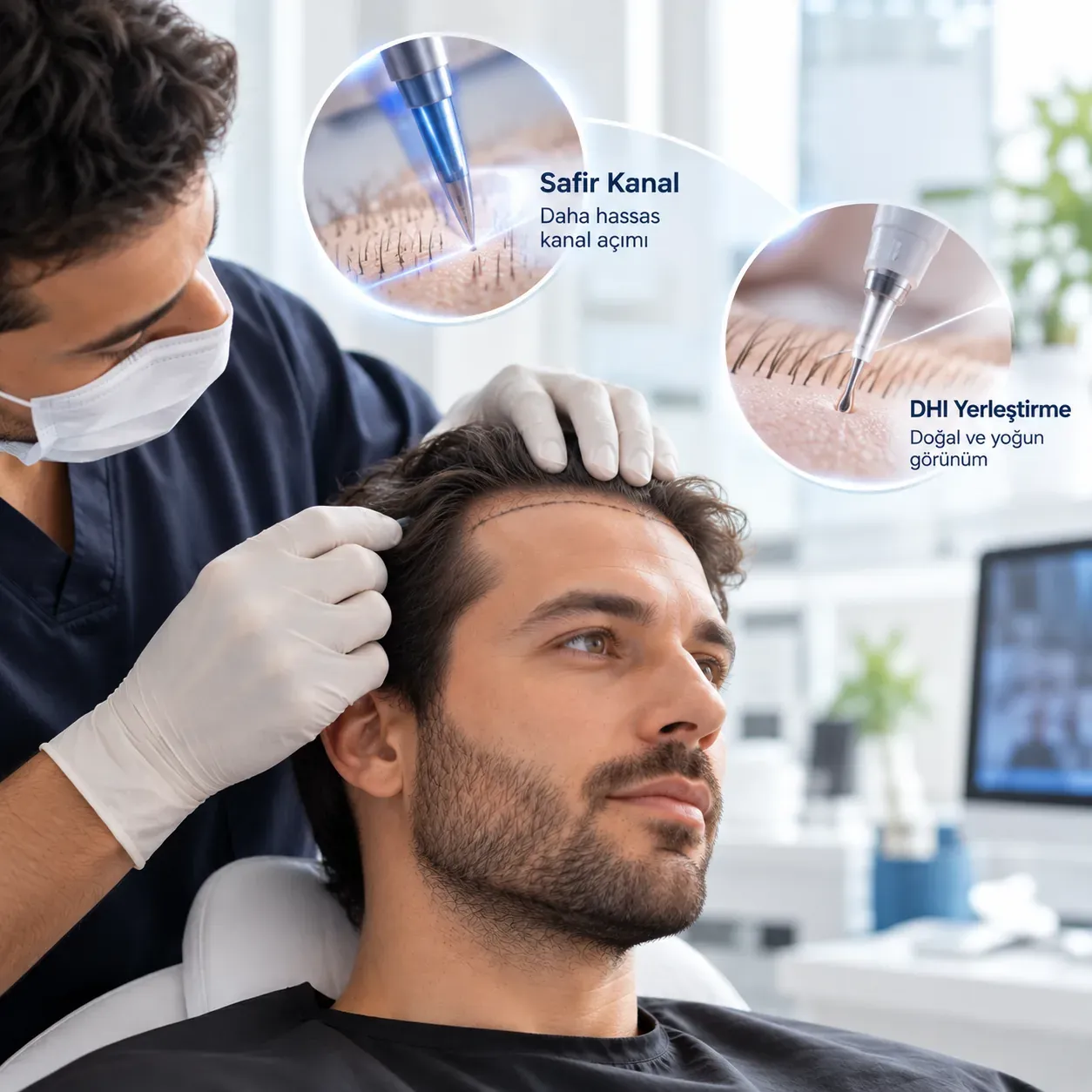
Max Hair Transplant is a clinic specific hair transplant protocol that brings together channel opening with sapphire tipped blades and graft placement with the DHI technique on an FUE foundation. Grafts are harvested one by one from the donor area, channels are opened in the recipient area with sapphire tips, and the grafts are placed into these channels with a Choi implanter pen. The procedure is performed in a single session, under local anesthesia and doctor supervision.
At Max Hair (Istanbul, Türkiye), this protocol is planned individually once the hairline, donor area, loss pattern and expectations have been reviewed in a doctor's assessment. In this article we explain why the two steps are combined, how the procedure day unfolds, how the method differs from other FUE applications, and how follow-up works. Results vary from person to person.
Why are sapphire channel opening and DHI placement combined?
In Sapphire FUE, the channels are opened with blades whose tip is made of sapphire mineral. A fine channel structure is aimed for with these tips; the angle, depth and direction of each channel are defined in advance according to the hairline plan. Channel geometry is a preparation step aimed at the fit between the graft site and the surrounding tissue.
In DHI, the grafts are loaded into a Choi implanter pen and placement is done with this pen. The pen is designed to control the angle, direction and depth of each graft at the moment of placement; this control stands out in areas where implantation among existing hair is required.
Max Hair Transplant uses these two steps in sequence: first the channels are opened with sapphire tips, then the grafts are placed into these channels with the implanter pen. In this way, the control offered by the sapphire tip in channel preparation and by the implanter pen in placement is targeted together within the same session. Which step carries more weight in which area is determined by the doctor's planning.
How does the procedure day unfold?
The procedure day is planned as a single session and usually takes 4 to 6 hours depending on the case. The duration varies with the condition of the donor area, the planned recipient area and the details of the application. You are discharged the same day.
- Doctor assessment: hairline design, donor area check and the final version of the individual plan.
- Preparation: preparing the application area and administering local anesthesia.
- Graft harvesting: taking the grafts one by one from the donor area with the FUE method.
- Channel opening: opening the channels in the recipient area with sapphire tipped blades at the planned angle and direction.
- Placement: loading the grafts into the Choi implanter pen and placing them into the channels with the DHI technique.
- Briefing: sharing the washing, care and check-up appointment instructions; discharge the same day.
How do Classic FUE, DHI, Sapphire FUE and Max Hair Transplant compare?
All four applications rely on harvesting grafts one by one from the donor area; the difference lies in how the channel opening and placement steps are carried out. The table below offers a factual summary; no row implies superiority over another.
The choice of method is made according to the donor area, the size of the area to be treated, the need to preserve existing hair and the doctor's assessment.
| Method | Channel opening | Placement | Duration | Anesthesia |
|---|---|---|---|---|
| Classic FUE | Separate step, at a natural direction and angle | Into the opened channel, as a separate step | 6-8 hours (single session) | Local anesthesia |
| DHI | With the Choi implanter pen, in one step together with placement | With the Choi implanter pen | 6-8 hours (single session) | Local anesthesia |
| Sapphire FUE | Separate step with a sapphire tipped blade | Into the opened channel, as a separate step | 4-6 hours (single session) | Local anesthesia |
| Max Hair Transplant | Separate step with a sapphire tipped blade | Into the opened channel with the Choi implanter pen (DHI) | 4-6 hours (single session) | Local anesthesia |
Who might Max Hair Transplant be considered for?
Suitability is determined by a doctor's assessment; the method is not recommended to anyone without an examination. The assessment considers donor area density, loss pattern, hairline expectations and general health together.
The following situations may be evaluated by the doctor for this protocol:
- Cases where the channel angle at the hairline and front area is to be defined in a planned way.
- Areas where implantation among existing hair is required and placement control comes to the fore.
- Recipient areas that can be planned in a single session under local anesthesia and that the doctor finds appropriate.
- People who want to start with an online pre-assessment and clarify the plan together with the doctor.
Who might it not be suitable for, and what are the possible side effects?
In some situations the doctor may prefer to postpone this protocol or suggest a different approach. These include an insufficient donor area, active scalp conditions, chronic diseases that are not under control, medication affecting bleeding tendency, or expectations that do not match what the application can offer. The decision is made after an examination and evaluation.
As with any surgical application, there are possible side effects; these are explained by the doctor before the procedure:
- Mild tenderness, redness or swelling in the recipient and donor areas in the first days.
- Temporary crusting and itching in the channel areas.
- Temporary shedding of the transplanted hairs in the first weeks (shock loss).
- Rarely, infection or a temporary feeling of numbness; in these cases the clinic should be contacted.
How do recovery and follow-up work?
Mild tenderness and temporary shedding in the first weeks after the procedure are normal; it is an expected part of the process for some of the transplanted hairs to shed early on. New growth occurs gradually over months and the appearance becomes more defined over time.
Washing and care guidance is shared by the team; topics such as the first wash, sleeping position and sun protection are part of this guidance. The follow-up process is planned to include check-up appointments, and at each appointment healing is monitored under doctor supervision.
Healing speed, growth timing and final appearance differ for each person; for this reason check-up appointments are not a formality but part of monitoring the process under doctor supervision. Results vary from person to person; this article is general information, not a diagnosis.
Frequently asked questions
Related treatments
Related pages
This article is for general information only and is not a diagnosis or a treatment recommendation. Suitability is determined by a doctor's assessment; results vary from person to person.