


Ice Cell Sapphire FUE: What Does Keeping Grafts in a Cold Environment Provide?
Key takeaways
- Ice Cell Sapphire FUE is an FUE based approach that combines channel opening with sapphire tipped instruments and keeping grafts in a cold cell environment throughout the procedure.
- The cold environment is a storage condition aimed at limiting the effect of heat and drying during the time the graft spends outside the body; on its own it is not a promise of results.
- Suitability for the method is determined by a doctor assessment; results vary from person to person.
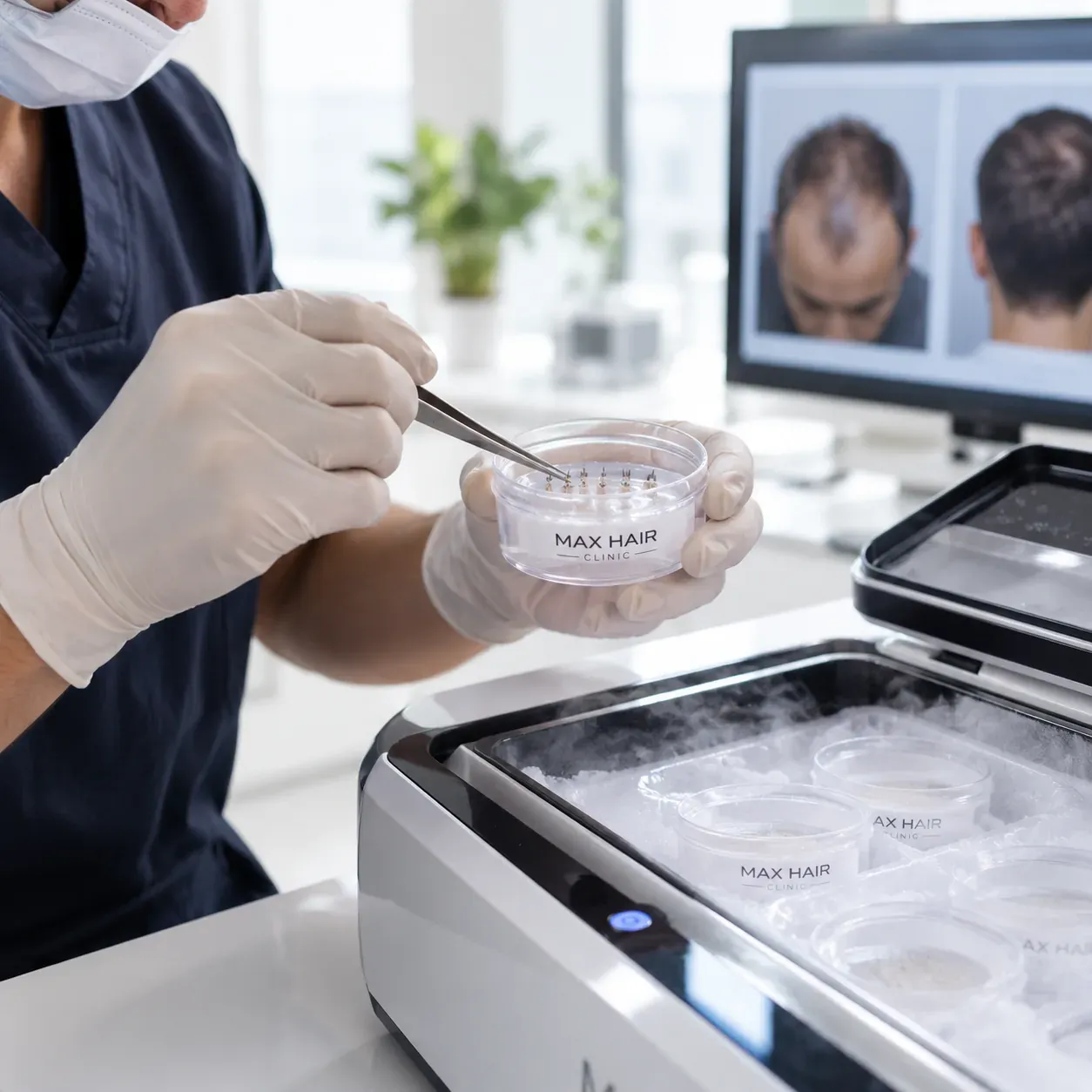
Ice Cell Sapphire FUE is an FUE based hair transplant approach in which grafts, once taken from the donor area, are kept in a cold cell (ice cell) environment throughout the procedure, and the channels are opened with sapphire tipped micro instruments. The cold environment is a storage condition aimed at limiting the load that factors such as heat and drying place on the tissue during the time the graft spends outside the body. The procedure is performed under local anaesthesia, usually in a single session and under doctor supervision.
At Max Hair (Istanbul, Türkiye), Ice Cell Sapphire FUE is planned as a clinic specific protocol after a doctor assessment and scalp analysis. In this article we explain, in factual terms, why the graft needs protection, where the cold environment sits in the procedure flow and how the approach differs from Sapphire FUE. Results vary from person to person.
What is a graft and why does it need protection outside the body?
A graft is a small piece of tissue taken one by one from the donor area during hair transplantation, containing one or several hair follicles. Each graft consists of the follicle, the connective tissue surrounding it and a small amount of fatty tissue. Until it is placed in the recipient area, this tissue waits outside the body without a blood supply.
During the time spent outside the body, the graft is sensitive to three basic factors: temperature, moisture and time. As the ambient temperature rises, the metabolic load on the tissue increases; loss of moisture can lead to drying. The longer the interval between extraction and placement, the greater the cumulative effect of these factors.
For this reason, the environment in which grafts are kept during hair transplantation is a planned part of the procedure. Keeping them at a low temperature and in a moist environment aims to reduce the metabolic load on the tissue and to limit drying. This is a general principle of tissue preservation; it does not promise a specific outcome.
Where does the cold environment approach sit in the procedure flow?
In Ice Cell Sapphire FUE, the cold cell environment covers the waiting phase from the extraction of the grafts to their placement. The cold environment is not an additional procedure but a storage step built into the standard FUE flow. The flow at Max Hair consists of the following steps.
The grafts remain in the cold environment while the channels are being opened, so the same storage condition is maintained for every waiting graft. The procedure is usually completed in 4 to 6 hours, in a single session.
- Doctor assessment, scalp analysis and preparation of the transplant plan.
- Administration of local anaesthesia and preparation of the donor area.
- Extraction of the grafts one by one from the donor area using the FUE method.
- Transfer of the extracted grafts into the cold cell environment, where they are kept until the moment of placement.
- Opening of the channels in the recipient area with sapphire tipped micro instruments.
- Placement of the grafts, taken from the cold environment, into the planned area.
- Sharing of aftercare instructions and scheduling of follow-up appointments.
What is the difference between Ice Cell Sapphire FUE and Sapphire FUE?
Both methods belong to the FUE family and use sapphire tipped instruments to open the channels. The difference lies in the condition under which the graft is kept outside the body: in Ice Cell Sapphire FUE, grafts are held in a cold cell environment throughout the procedure. Channel structure, type of anaesthesia and session planning are similar in both methods.
The table below compares the two approaches on factual headings only; it contains no ranking of superiority. Which approach is considered for you is determined during the doctor examination, according to your scalp structure and the planning.
| Item | Ice Cell Sapphire FUE | Sapphire FUE |
|---|---|---|
| Graft storage condition | Cold cell environment throughout the procedure | Clinic standard holding protocol |
| Channel opening instrument | Sapphire tipped micro instruments | Sapphire tipped blades |
| Duration | 4 to 6 hours (single session) | 4 to 6 hours (single session) |
| Anaesthesia | Local anaesthesia | Local anaesthesia |
| Follow-up | Follow-up appointments under doctor supervision | Follow-up appointments under doctor supervision |
Who may Ice Cell Sapphire FUE be considered for?
This approach may be considered for people who meet the general suitability criteria for FUE hair transplantation. These criteria include sufficient donor area density, a hair loss pattern that has settled into a stable course and a general state of health suitable for a surgical procedure.
The cold environment approach may be preferred by the doctor in plans where the interval between extraction and placement could be relatively long. In transplants covering a wide area, or in cases where the procedure is expected to take longer, the waiting time of the graft naturally increases.
Even so, the final decision is individual. The doctor determines whether this approach is suitable for you by assessing the hair and scalp analysis, the type of hair loss and your expectations together.
Who may it not be suitable for, and what are the possible side effects?
An active scalp infection, uncontrolled chronic diseases, conditions that increase the tendency to bleed or an insufficient donor area may lead to the hair transplant being postponed or not considered suitable. In people whose hair loss has not yet stabilised, the doctor may recommend waiting. These conditions are assessed by examination and, where necessary, additional tests.
The possible side effects are similar to those of other FUE applications: in the first days after the procedure, sensitivity, redness, temporary swelling and crusting may occur. It is an expected part of the process that some of the transplanted hairs shed in the early period. Rarely, infection or prolonged sensitivity may develop; these situations are managed with doctor follow-up.
Keeping grafts in a cold environment is a step relating to the storage condition of the graft; it does not remove the surgical risks of the procedure. Before the procedure, your doctor shares the possible side effects and the points to be aware of with you.
How do recovery and follow-up progress?
In the first days after the procedure the recipient area is sensitive; aftercare recommendations such as washing, sleeping position and sun protection are shared by the doctor in writing. Crusting usually resolves within the first weeks, and the donor area continues to heal during this period.
Some of the transplanted hairs may shed in the early period; new growth begins gradually over the following months, and the appearance becomes more defined over time. This timeline varies from person to person.
At Max Hair, follow-up appointments are a planned part of the process; progress is assessed by the doctor and aftercare recommendations are updated where necessary. For patients travelling from abroad, follow-up can be continued through remote photo sharing and scheduled check-ups.
Frequently asked questions
Related treatments
Related pages
This article is for general information only and is not a diagnosis or a treatment recommendation. Suitability is determined by a doctor's assessment; results vary from person to person.