


Hydrafacial Skin Care: How Is It Performed and Who Is It Suitable For?
Key takeaways
- Hydrafacial is a hydrodermabrasion based skin care treatment in which the skin goes through cleansing and light peeling, vacuum pore cleansing, and serum and hydration stages.
- Session frequency does not follow a fixed calendar; it is set by the specialist's plan and a doctor's assessment according to skin type and needs.
- Hydrafacial and a classic facial differ in how the stages are carried out, not in superiority; both are periodic care approaches.
Hydrafacial is a hydrodermabrasion based skin care treatment: the skin is cleansed and lightly exfoliated, pores are cleansed with a vacuum tip, and serums and moisturisers are then applied. The aim is to support a cleaner, more hydrated and fresher looking complexion. The treatment usually takes 30-60 minutes; it requires no anaesthesia and, in most cases, no recovery time.
At Max Hair, Hydrafacial skin care is performed by a specialist at our clinic in Istanbul, Türkiye, and planned with a doctor's assessment. Skin type, sensitivity and the products you currently use are reviewed before the treatment. Results vary from person to person.
What does hydrodermabrasion based skin care mean?
Hydrodermabrasion is a care approach in which the skin surface is cleansed with liquid solutions and a vacuum tip. The aim is to remove dead cells, excess sebum and impurities from the skin surface in stages.
Unlike mechanical dermabrasion, the procedure is carried out with liquid and suction. Hydrafacial is used here as the name of the service; which solutions and serums are used is decided according to skin type. It is a periodic skin care treatment, not a medical therapy.
What stages does a Hydrafacial treatment involve?
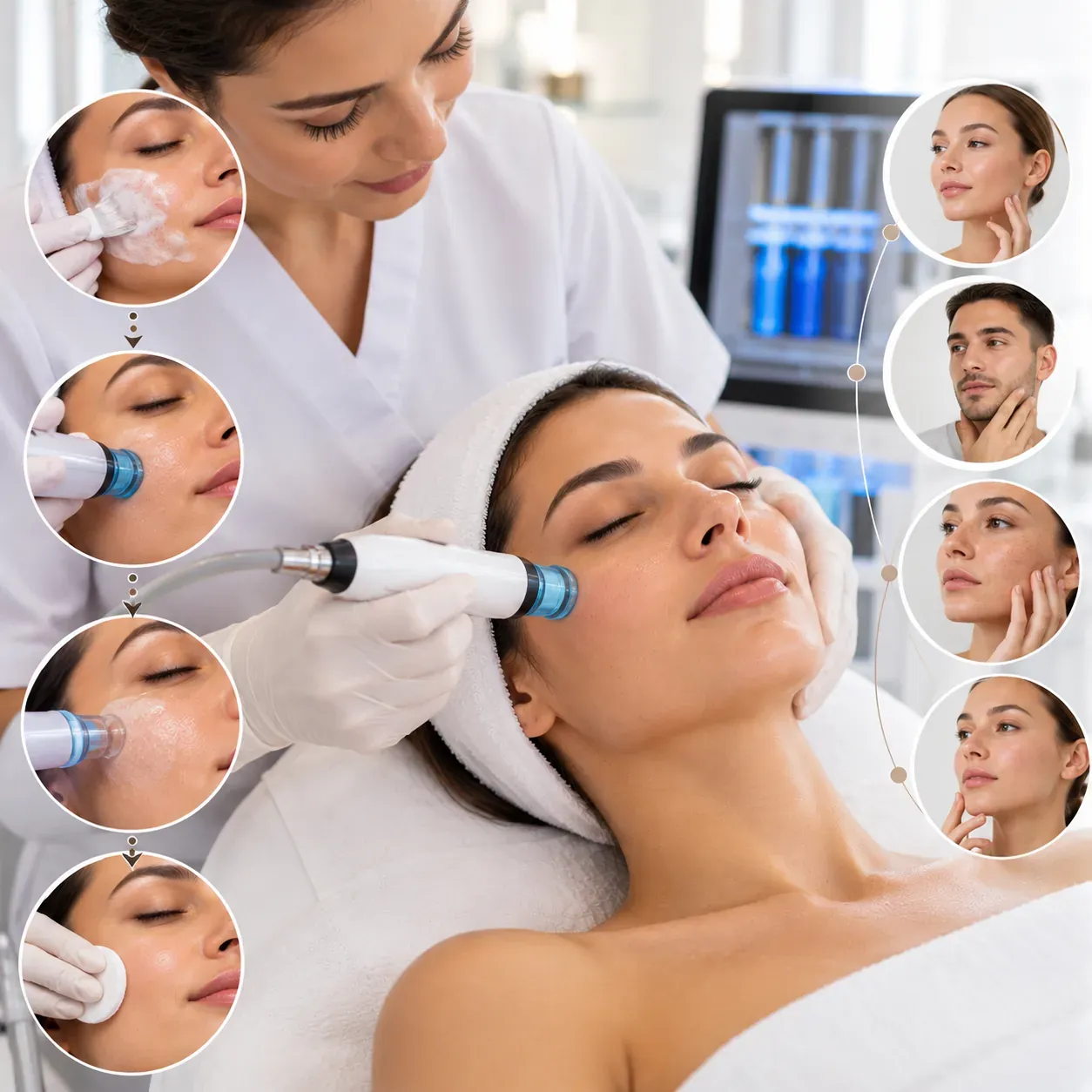
The treatment usually takes 30-60 minutes, requires no anaesthesia, and its steps are adapted to skin type. The light peeling stage is not a separate chemical peel; it is a superficial exfoliation that forms part of the treatment. The treatment follows these steps:
- Skin analysis and planning: skin type, sensitivity, current products and medications are discussed with the specialist; a doctor's assessment is requested if needed.
- Cleansing and light peeling: make-up and surface impurities are removed, and a superficial exfoliation aimed at removing dead cells is carried out.
- Vacuum pore cleansing: a vacuum tip is used with the aim of removing excess sebum and impurities that have built up in the pores.
- Serum and hydration: serums and moisturising products chosen according to skin type are applied.
- Sun protection and aftercare advice: the treatment ends with sunscreen, and home care recommendations for the following days are shared.
What is felt during and right after Hydrafacial?
Hydrafacial is a treatment that does not require anaesthesia. A cool, wet sensation may be felt during the cleansing stage, and a light pulling sensation on the skin during the vacuum stage. For sensitive skin, the specialist adjusts the intensity of application to this sensitivity.
Mild redness may appear right after the treatment; this is usually temporary. When make-up and products with strong active ingredients can be used again is advised by the specialist according to the condition of the skin.
How is Hydrafacial assessed for different skin types?
Hydrodermabrasion based care can be adapted to different skin types; adaptation is made through the choice of solutions and serums and the intensity of application. However, priorities differ for each skin type and are set before the treatment:
- Oily and combination skin: sebum build-up in the pores and a shiny appearance are prioritised during the cleansing and vacuum stages.
- Dry skin: when moisture loss and a dull appearance are prominent, more emphasis is placed on the serum and hydration stage.
- Sensitive skin: for skin prone to redness, the intensity of application and product choice are planned carefully; in some cases a doctor's assessment is requested first.
- Acne-prone skin: the treatment may be considered during non-inflamed periods; for inflamed or widespread acne, the doctor decides whether medical treatment is needed.
- Skin prone to pigmentation: Hydrafacial is not a pigmentation treatment; the type of spot is assessed separately by a doctor, and sun protection becomes part of the plan.
How often are Hydrafacial sessions planned?
There is no fixed calendar for session frequency that suits everyone. Intervals are set by the specialist's plan, with a doctor's assessment, by considering skin type, the aim of care, the season and how the skin responded to the previous session.
Repeating the treatment at very short intervals may cause irritation, especially in sensitive skin; this is why the skin's recovery is also considered when setting intervals.
Hydrafacial is usually thought of as part of a periodic care routine rather than a stand-alone course. Cleansing, moisturising and sun protection at home are an important part of the time between sessions. Results vary from person to person.
What is the difference between Hydrafacial and a classic facial?
Both are periodic treatments aimed at cleansing the skin and supporting hydration; the difference lies in how the stages are carried out. The table below compares application characteristics only; it contains no superiority or outcome claims.
Which treatment is appropriate is planned by taking skin type and personal expectations into account. For some people, a routine that includes both treatments at different times may also be considered.
| Feature | Hydrafacial skin care | Classic facial |
|---|---|---|
| Basic approach | Hydrodermabrasion based; staged care with liquid solutions and a vacuum tip | Sequential care steps applied with products |
| Stages | Cleansing and light peeling, vacuum pore cleansing, serum and hydration | Cleansing, toner, peeling, pore cleansing, mask, moisturising |
| Duration | Usually 30-60 minutes | Usually 45-60 minutes |
| Anaesthesia | Not required | Not required |
| Frequency | According to skin type, planned by the specialist | Periodic, according to skin type |
| Possible temporary effects | Redness, sensitivity | Redness, sensitivity |
| Planning | By a specialist, with a doctor's assessment | By a specialist, with a doctor's assessment |
What can realistically be expected from Hydrafacial?
Hydrafacial is a treatment focused on the skin's cleansing and hydration needs; it is not presented as a stand-alone solution for deep wrinkles, marked pigmentation or acne scars. After the treatment, the aim is for the skin to look cleaner and more hydrated; how noticeable this effect is and how long it lasts varies from person to person.
If a specific skin need calls for a different approach, options such as pigmentation care, acne care or anti-ageing skin care can be discussed separately during the doctor's assessment. The aim is to focus on a plan that suits the skin's needs rather than on a single procedure.
Who may Hydrafacial not be suitable for, and what are the possible side effects?
The treatment may be postponed for people with an active infection, an open wound or a recent severe sunburn in the treatment area. If there is active, inflamed acne or a flare-up of a condition affecting the skin, a doctor's assessment is needed first.
Certain topical or oral medications that make the skin more sensitive, other recent skin treatments and pregnancy should be shared before the treatment. Suitability is decided with a doctor's assessment.
Possible side effects are usually temporary: redness and sensitivity may occur after the treatment. If these effects last longer or become more pronounced, contacting the clinic is recommended. Results vary from person to person.
What should be considered before and after Hydrafacial?
Before the treatment, the skin care products you use, especially those containing acids or retinoids, should be shared with the specialist. Recent intense sun exposure is also taken into account in planning.
In the first days after the treatment, avoiding intense sun, using sunscreen and pausing products that may irritate the skin for a while are usually recommended. Individual instructions always take priority over general information.
Frequently asked questions
Related treatments
Related pages
This article is for general information only and is not a diagnosis or a treatment recommendation. Suitability is determined by a doctor's assessment; results vary from person to person.