


How Is Graft Need Planned in Hair Transplant? A Guide to the Norwood Scale
Key takeaways
- The Norwood scale is a classification tool that shows the stage of male pattern hair loss; it does not determine the number of grafts on its own.
- Graft need is planned by assessing donor density, hair thickness and texture, the size of the thinning area, the desired density, and age and the progression of hair loss together.
- Because the donor area is a limited resource, the exact number of grafts is determined by the doctor's assessment after an examination.
In hair transplant, graft need is planned by assessing together the size of the thinning area, the density of the donor area, the thickness and texture of the hair, the targeted density, and age and the progression of hair loss. The Norwood scale is a classification tool that describes the stage of male pattern hair loss, and it is only one part of this assessment. How many grafts are planned is determined by the doctor's assessment after an examination.
At Max Hair, graft planning is carried out under doctor supervision at our clinic in Istanbul, Türkiye. This guide explains the Norwood stages, the factors that affect graft need and how the planning consultation proceeds, for general information purposes. Results vary from person to person.
What is a graft, and why is planning based on grafts?
A graft is the smallest unit harvested from the donor area and transplanted in a hair transplant; it is a follicular cluster containing one to four hairs. Grafts are harvested one by one from the donor area with FUE and placed in the planned area following the natural direction and angle.
Because the number of hairs per graft varies from person to person, planning is based on grafts and their distribution rather than on the number of hairs. Single-hair grafts are usually planned for the very front row of the hairline, while multi-hair grafts are planned for areas further back to build density.
What is the Norwood scale?
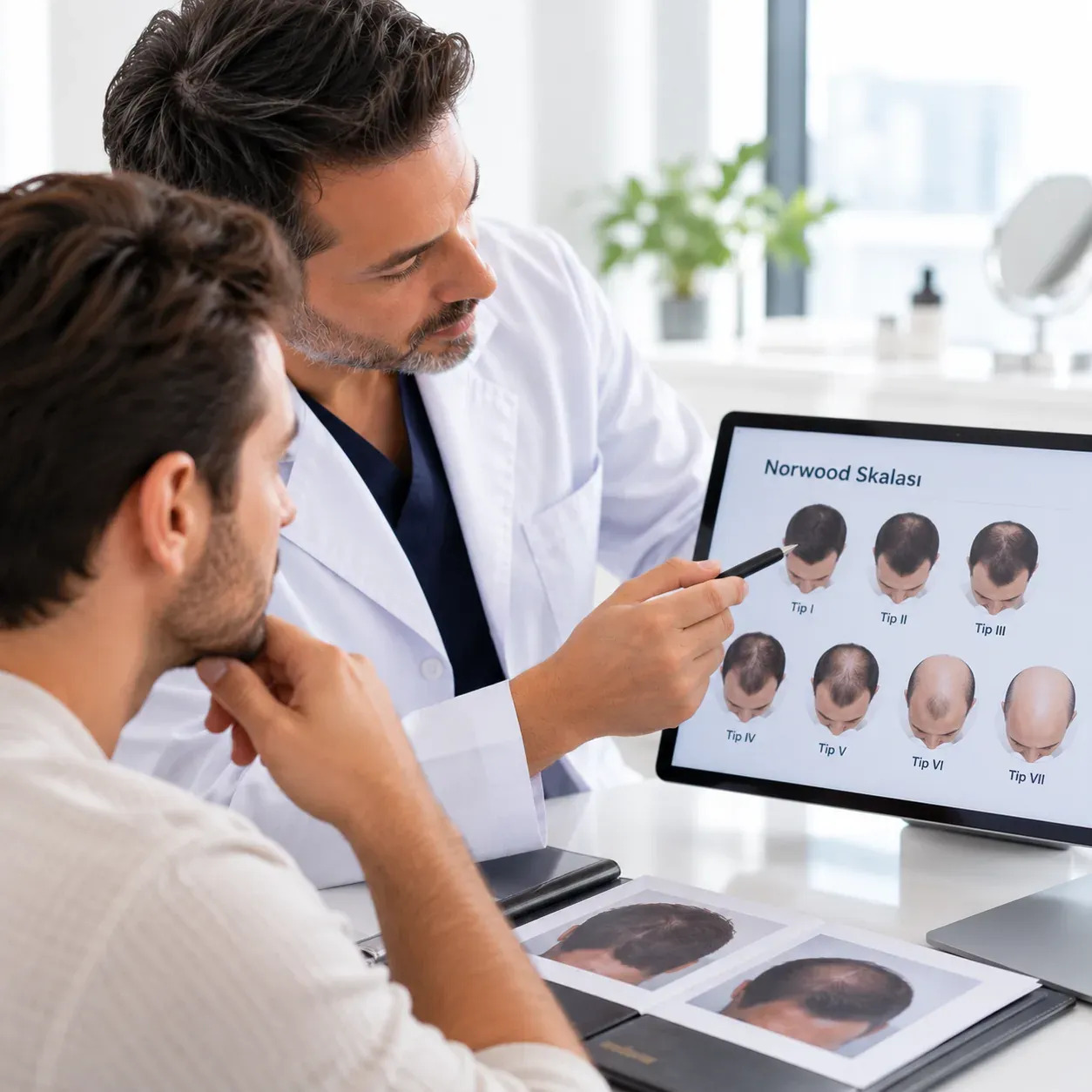
The Norwood scale, also known as the Hamilton-Norwood classification, is a system that describes male pattern (androgenetic) hair loss in seven main stages. The stages track the recession of the front hairline and thinning at the crown together.
The scale makes it easier to describe the location and extent of hair loss in a shared language during the planning consultation. However, it is not a diagnosis or a treatment prescription; two people at the same stage may have very different donor areas and hair characteristics.
Because female pattern thinning progresses in a different pattern, it is usually assessed with separate classifications such as the Ludwig scale.
What are the stages of the Norwood scale?
The table below summarises the affected area and typical appearance at each stage. It contains no graft numbers; different plans may come up at the same stage.
The scale also defines a type called the A variant: here the front hairline recedes as a whole without leaving a central island of hair, and the crown is usually not affected in the early period.
| Stage | Affected area | Typical appearance |
|---|---|---|
| Norwood 1 | Front hairline | No noticeable recession, or very slight |
| Norwood 2 | Temples | Mild, usually symmetrical recession at the temples |
| Norwood 3 | Temples and front hairline | Deepening recession at the temples; considered the stage at which clinically noticeable hair loss begins |
| Norwood 3 vertex | Crown (vertex) and temples | Thinning at the crown; recession at the temples remains limited |
| Norwood 4 | Front area and crown | Progressing loss at the front and noticeable thinning at the crown; a band of hair between the two areas is preserved |
| Norwood 5 | Front area and crown | The band between them narrows and thins; the affected areas widen |
| Norwood 6 | Front, mid-scalp and crown | The band disappears and the front and crown merge into a single open area; hair remains at the sides and back |
| Norwood 7 | The entire top of the scalp except the sides and back | Only a narrow horseshoe-shaped band of hair remains at the sides and nape |
Which factors determine graft need?
Graft need does not depend on a single measure; the doctor proposes a plan by assessing the following factors together. When one of the factors changes, the plan proposed for the same thinning area may change as well:
- Donor density: the density of follicles at the back and sides of the head determines how many grafts can be harvested without leaving a thin appearance in the donor area.
- Hair thickness and texture: thick, wavy or curly hair may give a different impression of coverage than fine, straight hair with the same number of grafts; the contrast between hair and skin colour also affects this impression.
- Size of the thinning area: the Norwood stage and the extent of the affected area shape which zones the grafts are distributed to and in what order.
- Desired density: the targeted look may require prioritising between the front hairline and the crown, and it is planned realistically together with the available donor capacity.
- Age and the progression of hair loss: because hair loss may progress at a younger age, the plan considers not only the current thinning but also areas that may thin in the future and the donor reserve.
- Condition of existing hair: in areas that are thinning but not fully bald, implantation among existing hair can be planned while preserving it; this affects both distribution and the choice of method.
How does donor capacity affect planning?
The donor area is the region at the back and sides of the head where follicles resistant to hair loss are found, and it is a limited resource. Because an extracted follicle does not grow back in its original place, the doctor plans a harvesting amount and distribution that preserve the natural appearance of the donor area.
At advanced stages, the thinning area may be larger than what the donor area can cover. In this case the doctor may suggest prioritising the front area that frames the face, or approaching session planning according to graft need and the size of the area.
In plans made at a younger age, leaving a donor reserve for needs that may arise later is also part of this assessment.
Why may two people at the same Norwood stage need different numbers of grafts?
The Norwood stage describes where the thinning is, but it does not measure head size, donor density or hair characteristics. For this reason, the fixed graft tables by stage that are often seen online cannot replace an individual plan.
For example, at the same stage, the approach to reaching the targeted look may differ for someone with thick, wavy hair and someone with fine, straight hair. Similarly, the plan for a young person whose hair loss is progressing quickly is approached differently from that of a person whose hair loss has been stable for a long time.
The exact number of grafts is therefore determined by the doctor's assessment after an examination. Results vary from person to person.
How is graft planning done during the consultation?
Planning starts with an online pre-assessment and is finalised in the planning consultation with the doctor. The online pre-assessment provides preliminary information; the final plan is determined by the doctor after the scalp has been examined in person.
The process usually follows these steps:
- Online pre-assessment: photos are shared via WhatsApp or the online form; the hair loss pattern and donor area are referred for the doctor's assessment.
- Scalp and donor examination: donor density, hair thickness and the condition of the scalp are examined in person.
- Medical history: medications, chronic conditions and the course of hair loss are reviewed.
- Hairline design: a hairline suited to facial proportions and age is decided together and marked.
- Prioritisation and method: the distribution of grafts across zones and which method, such as Classic FUE, DHI or Max Hair Transplant, is appropriate are discussed.
- Plan and expectations: the proposed plan, session approach and recovery timeline are shared with you.
Who may hair transplant not be suitable for, and what are the possible side effects?
In people with an insufficient donor area, hair loss that is not yet stable and is progressing widely, an active infection or inflammatory condition of the scalp, or an uncontrolled chronic illness, the doctor may postpone the transplant or recommend a different approach. Unrealistic density expectations are also part of the suitability assessment.
Possible side effects include temporary swelling, redness, crusting, tenderness, a feeling of numbness and temporary shedding in the first weeks; infection or inflammation of the hair follicles (folliculitis) may rarely develop. These effects are followed up by the doctor through care instructions and follow-up appointments.
Frequently asked questions
Related treatments
Related pages
This article is for general information only and is not a diagnosis or a treatment recommendation. Suitability is determined by a doctor's assessment; results vary from person to person.