


Sapphire FUE Hair Transplant: How Does It Differ from Classic FUE?
Key takeaways
- The difference between Sapphire FUE and Classic FUE lies in the instrument that opens the channels in the recipient area, not in graft harvesting.
- With its fine and smooth structure, the sapphire tip is designed to open finer channels and to reduce tissue trauma.
- Both methods are performed under local anesthesia, in a single session and under doctor supervision; results vary from person to person.
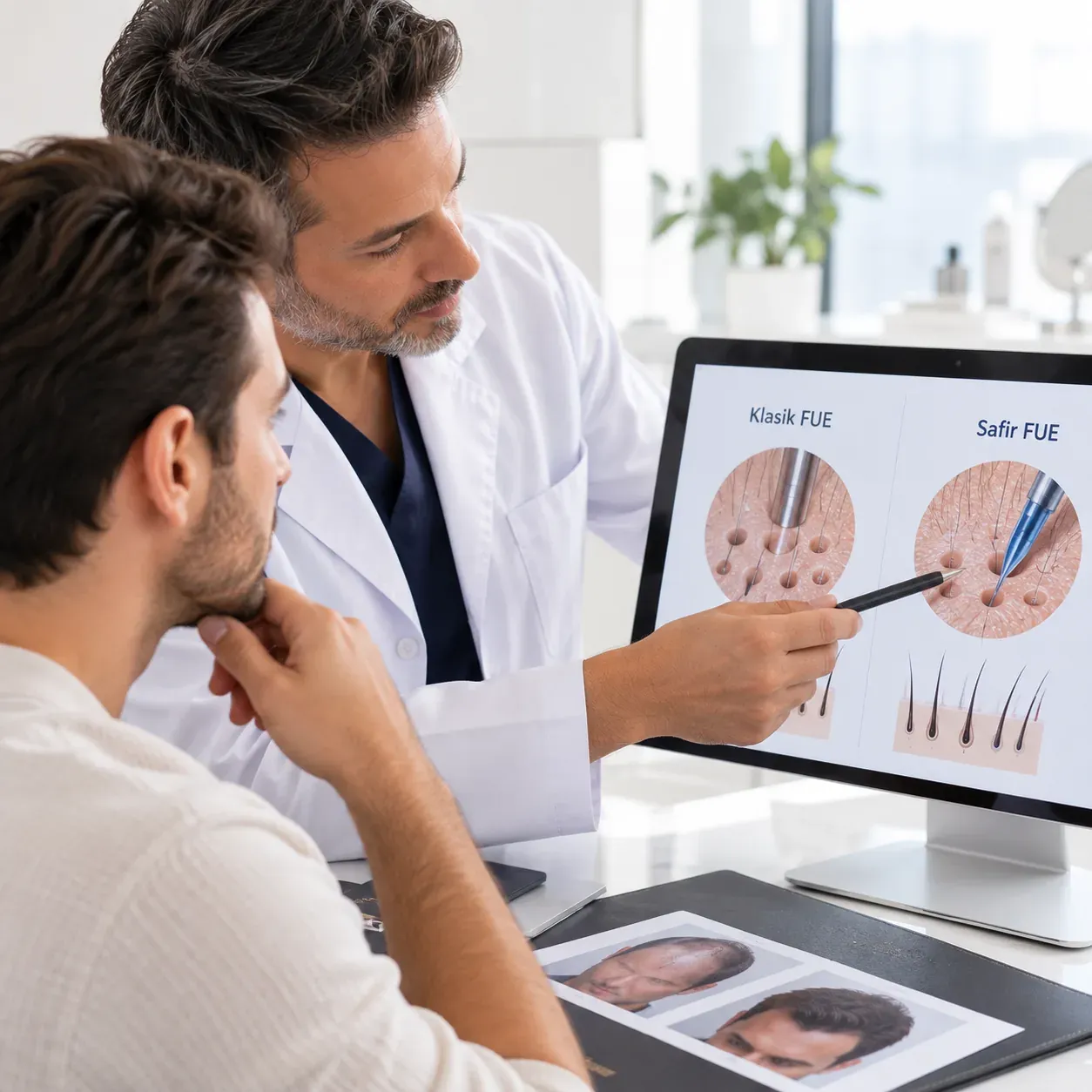
Sapphire FUE hair transplant is a variant of FUE in which the channels in the recipient area are opened with sapphire tipped blades. The stage in which grafts are harvested one by one from the donor area with a micro motor is the same as in Classic FUE. The difference is that the channels are opened with a fine, smooth surfaced sapphire tip instead of a steel slit tip.
At Max Hair, Sapphire FUE and Classic FUE are planned at the clinic in Istanbul, Türkiye, under local anesthesia and doctor supervision. Which method is considered is decided through a doctor assessment that takes into account the pattern of hair loss, donor area density and general health. Results vary from person to person.
What does the sapphire tip do when opening channels?
In the FUE method, after the grafts have been harvested, a small channel is opened in the recipient area for each graft. The direction, angle and depth of these channels are set by the doctor so that they match the natural growth direction of the hair. The tip of the instrument used to open the channel directly affects the width and edge structure of the channel.
The tips of the blades used in Sapphire FUE are made of sapphire mineral. The sapphire tip is fine, hard and smooth surfaced; it is designed to open finer channels with smoother edges than steel slit tips. This design aims to reduce the pressure applied to the surrounding tissue while the channel is being opened.
A finer channel can make it easier to plan placing grafts closer together. However, channel density and the placement plan are determined by the doctor according to the structure of the graft and the condition of the recipient area. The sapphire tip is a tool; what shapes the outcome is the planning and the application as a whole.
What are the differences between Classic FUE and Sapphire FUE?
The two methods follow the same framework in terms of graft harvesting, graft placement, anesthesia and session structure. The table below offers a factual comparison under the headings of channel opening instrument, channel geometry, duration and recovery period. The table makes no claim of superiority; which method is considered depends on the doctor assessment.
| Feature | Classic FUE | Sapphire FUE |
|---|---|---|
| Channel opening instrument | Steel slit tip | Sapphire tipped blade |
| Channel geometry | Standard channel opened with a steel tip | A finer channel with smoother edges is aimed for |
| Graft harvesting | One by one with a micro motor | One by one with a micro motor (same) |
| Graft placement | With forceps, as a separate step | With forceps, as a separate step |
| Typical duration | 6 to 8 hours (single session) | 4 to 6 hours (single session) |
| Anesthesia | Local anesthesia | Local anesthesia |
| Shaving requirement | Usually required | Usually required |
| Recovery period | Varies from person to person | Varies from person to person |
How does the Sapphire FUE procedure day unfold?
The procedure day begins with a doctor assessment and is planned to be completed in a single session. The steps largely overlap with Classic FUE; the only difference is the instrument used at the channel opening stage. A typical flow is as follows.
- Doctor assessment, hairline planning and preparation of the application area
- Application of local anesthesia to the donor and recipient areas
- Harvesting the grafts one by one from the donor area with a micro motor using the FUE method
- Keeping the harvested grafts under suitable conditions until placement
- Opening the channels in the recipient area with sapphire tipped blades at the natural direction and angle
- Placing the grafts into the opened channels with forceps
- Sharing aftercare instructions and follow-up appointments
Who may Sapphire FUE be considered for?
Sapphire FUE is an option that may be considered for people for whom the FUE method is suitable. Suitability is determined individually by the doctor, taking into account the pattern of hair loss, the density of the donor area and general health. The final decision is made after an examination and assessment.
The doctor assessment usually considers the following points together. No single criterion is decisive on its own; the overall picture is interpreted as a whole.
- Type and progression of hair loss
- Presence of sufficient healthy grafts in the donor area
- Size of the area to be treated and the planned hairline
- General health and regularly used medications
- Expectations that are in line with the nature of the process
Who may it not be suitable for, and what are the possible side effects?
In people with an insufficient donor area, an active scalp condition or a chronic illness that is not under control, the procedure may be postponed or a different approach may be suggested. In very young candidates whose hair loss is progressing rapidly, the doctor may defer planning to a later date. These situations are clarified case by case through the doctor assessment.
Sapphire FUE is a surgical procedure and, as with any surgical procedure, there are possible side effects. These are usually temporary and are followed with the aftercare recommendations given by the doctor. In case of anything unexpected, contacting the clinic is advised.
- Mild redness, swelling and crusting in the transplanted area
- Temporary numbness or tenderness in the donor and recipient areas
- Itching during the healing process
- Early shedding of some of the transplanted hairs (shock loss)
- Rarely, infection or folliculitis
How do recovery and follow-up work?
In the first days after the procedure, mild redness, swelling or crusting may appear in the transplanted area; these are usually temporary. The first wash is done according to the clinic's instructions and in the way demonstrated. During the crusting period it is advised not to touch the transplanted area and to protect it from the sun.
It is an expected part of the process that some of the transplanted hairs shed early and that new growth begins gradually over the following months. The speed of healing, the timing of growth and the appearance vary from person to person. For this reason, follow-up appointments and the follow-up process are planned as part of the procedure.
At Max Hair, the follow-up process is carried out under doctor supervision and a line of contact with the clinic stays open for your questions. Method choice, the procedure day and the follow-up plan are arranged separately for each person. Results vary from person to person.
Frequently asked questions
Related treatments
Related pages
This article is for general information only and is not a diagnosis or a treatment recommendation. Suitability is determined by a doctor's assessment; results vary from person to person.