


What Is DHI Hair Transplant? Advantages and Who Is It Suitable For?
Key takeaways
- DHI is a hair transplant method in which grafts are implanted with the Choi implanter pen, opening the channel and placing the graft in a single step.
- DHI and Classic FUE differ in application, not in superiority; the choice of method depends on the doctor's assessment.
- A narrow donor area, preservation of existing hair and a preference for no shaving are the main situations in which DHI may be considered.
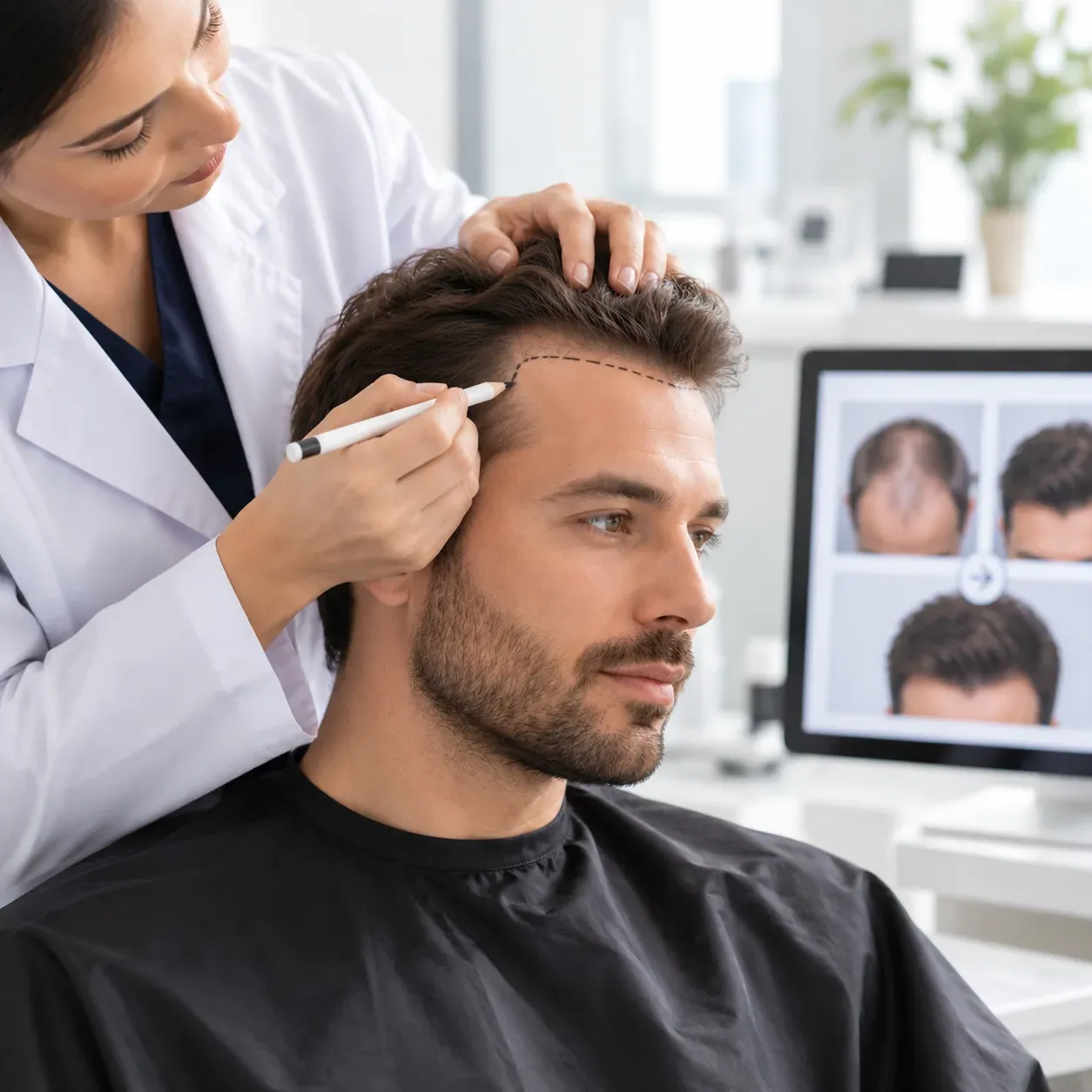
DHI (Direct Hair Implantation) is a hair transplant method in which follicles are harvested one by one from the donor area and placed directly into the recipient area with a dedicated instrument called the Choi implanter pen. Its key difference from Classic FUE is that channel opening and graft placement are carried out in a single movement rather than as separate steps. This allows the direction, angle and depth of each graft to be controlled with the pen.
At Max Hair, DHI hair transplant is planned under doctor supervision at our clinic in Istanbul, Türkiye. Whether the method suits you is determined by the doctor after an assessment of your hair loss pattern and donor area. Results vary from person to person.
How is DHI hair transplant performed?
DHI is performed under local anaesthesia and typically takes 6-8 hours in a single session. The duration may vary with the size of the planned area and the pace of graft harvesting. The procedure follows these steps:
- Doctor assessment and hairline planning: hair loss pattern, donor capacity and expectations are discussed.
- Local anaesthesia: the donor and recipient areas are numbed with local anaesthesia.
- Graft harvesting from the donor area: grafts are extracted one by one with micro motor tips.
- Loading grafts into the Choi pen: the harvested grafts are placed into implanter pens by the team.
- Single step channel opening and placement: as the pen tip enters the skin it opens the channel and releases the graft in the same movement.
- Dense, naturally distributed implantation: direction and angle follow the growth direction of the existing hair.
- Post-procedure briefing: washing, sleeping position and the follow-up schedule are explained by the doctor.
What are the notable features of the DHI method?
The most frequently mentioned feature of DHI is that the graft is placed with the pen rather than being held with forceps (no-touch). Because channel opening and placement happen at the same time, direction, angle and depth are set with a single instrument.
This approach gives the doctor additional planning room in cases where grafts need to be placed among existing hair. Depending on the case, the recipient area can also be planned with regional shaving or without shaving.
None of these features makes DHI superior to other methods on its own. Which method is appropriate is determined by the doctor by assessing the donor area, the recipient area and personal goals together.
What are the differences between Classic FUE and DHI?
Both methods rely on harvesting grafts one by one from the donor area; the difference lies in the placement stage. The table below compares application characteristics only; it contains no outcome or superiority claims.
In terms of duration and anaesthesia the two methods are similar. The shaving requirement and the placement instrument are practical differences that may matter when planning your return to daily life. Which method is chosen depends on the doctor's assessment.
| Feature | Classic FUE | DHI |
|---|---|---|
| Channel opening | Steel slit tip, as a separate step | Choi pen, in one step together with placement |
| Placement instrument | Forceps | Choi implanter pen (no-touch) |
| Density approach | Channels are opened first, grafts are placed according to the planned distribution | Dense, naturally distributed implantation among existing hair can be planned |
| Duration | 6-8 hours (single session) | 6-8 hours (single session) |
| Anaesthesia | Local anaesthesia | Local anaesthesia |
| Shaving requirement | Usually required | Can be applied unshaven (regional) |
Who may DHI be considered for?
DHI is not the first choice for every type of hair loss; it is considered by the doctor in specific situations. The main situations in which DHI may come up during the planning consultation are:
- Narrow donor area: cases where a limited number of grafts is planned to be placed with direction and angle control.
- Situations where existing hair must be preserved: implantation among existing hair in thinning areas to add density.
- Preference for no shaving: people who do not wish to cut their hair short for work or social reasons; depending on the case, regional shaving or no shaving can be planned.
- Areas with high sensitivity to direction, such as the front hairline and crown: zones where controlling the graft angle with the pen makes planning easier.
- Hair transplant in women: when working without shortening the hair is requested, the doctor may consider DHI among the options.
Who may DHI not be suitable for, and what are the possible side effects?
When a large area needs to be covered in a single session, the doctor may recommend a method in which channel opening and placement are done separately instead of DHI. The procedure may be postponed in people with an insufficient donor area, in younger people whose hair loss pattern has not yet settled, or in those with an active scalp condition.
Uncontrolled chronic conditions, bleeding disorders and certain medications should be shared with the doctor before planning. Unrealistic expectations are also part of the suitability assessment.
Possible side effects are similar to other hair transplant methods: swelling, redness, crusting, temporary numbness and tenderness may occur in the recipient and donor areas. Folliculitis or infection may rarely develop; these are managed by the doctor at follow-up appointments. Results vary from person to person.
How do recovery and follow-up progress after DHI?
Crusting in the recipient area during the first days is an expected phase, and the first wash is done under the doctor's guidance. In the early period, sun protection, avoiding strenuous exercise and not touching the recipient area are recommended.
Shedding of some of the implanted hair in the first weeks (shock loss) is common and temporary. It takes months for new hair to become visible; the final assessment is usually made towards the end of the first year.
At Max Hair, follow-up is planned with control appointments and, where needed, supportive applications. Individual instructions always take priority over general information.
How is the decision between DHI and Classic FUE made?
The decision starts from an individual assessment, not from the name of the method. The doctor proposes a plan by considering donor capacity, the size of the recipient area, existing hair density and the shaving preference together.
In some cases the two approaches can be combined in the same plan; for example, DHI at the front hairline and channel-based placement in larger areas. These combinations are planned by the doctor as a clinic-specific protocol.
Frequently asked questions
Related treatments
Related pages
This article is for general information only and is not a diagnosis or a treatment recommendation. Suitability is determined by a doctor's assessment; results vary from person to person.