


Beard and Eyebrow Transplant: Planning, Process and Recovery
Key takeaways
- Beard and eyebrow transplants are surgical procedures performed under local anaesthesia in which grafts taken from the donor area are placed one by one in line with the natural hair direction.
- In both procedures, planning is built on direction, angle and density, and the design is created together with the doctor according to facial features.
- An eyebrow transplant is a surgical graft transfer, whereas eyebrow microblading is a non surgical application that creates hair-like strokes in the skin with pigment, and the pigment fades over time.
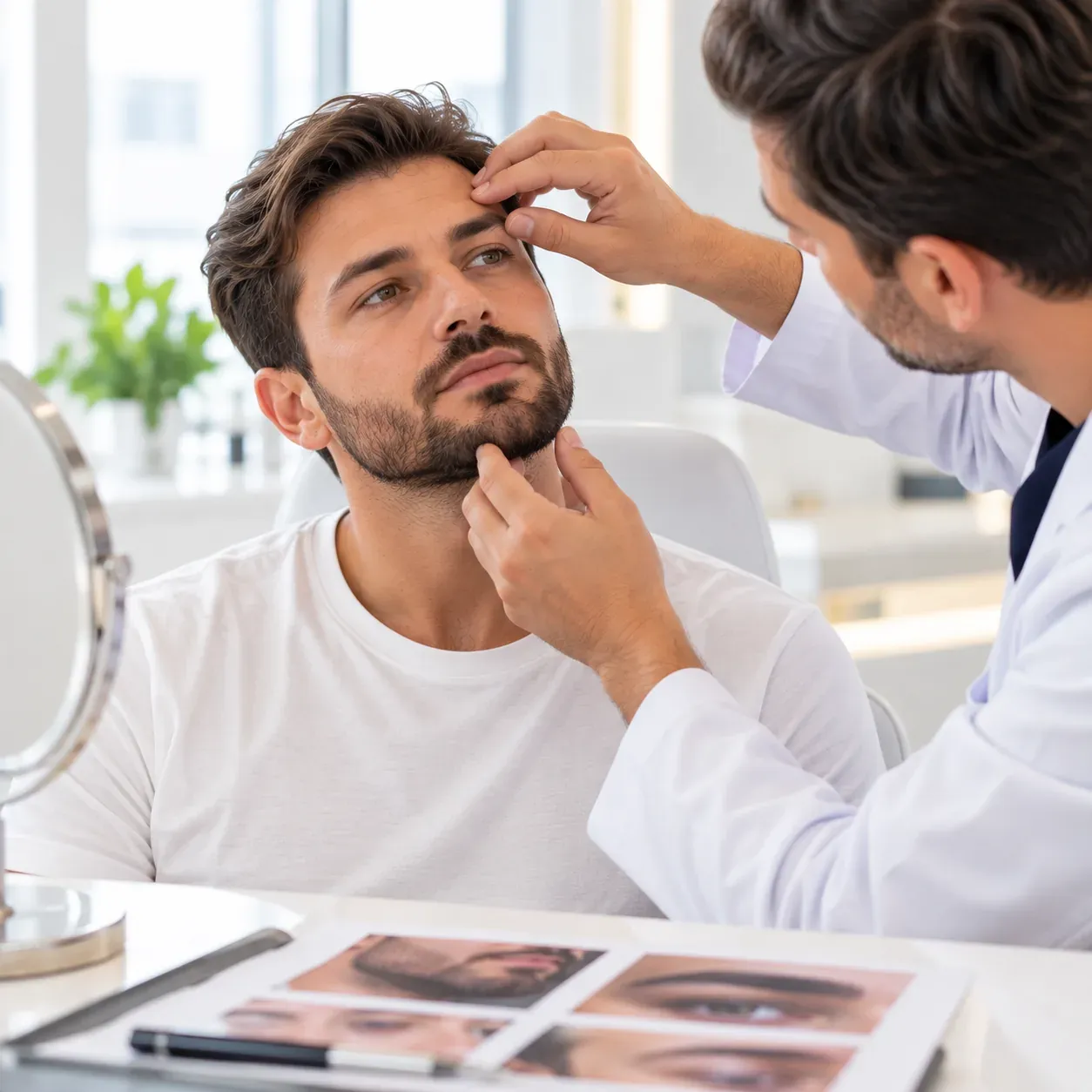
Beard and eyebrow transplants are surgical procedures in which grafts taken from the donor area are placed one by one into sparse, patchy or bare regions in line with the natural hair direction. Both are performed under local anaesthesia, and the design is planned together with the doctor according to facial features. The three core elements of planning are direction, angle and density.
At Max Hair, beard and eyebrow transplants are planned under doctor supervision at our clinic in Istanbul, Türkiye. Suitability is determined after a preliminary examination in which the donor area, the existing hair structure and expectations are assessed. Results vary from person to person.
In which areas and for whom is a beard transplant considered?
A beard transplant is considered for sparse, patchy or bare areas on the cheeks, chin and sideburns. Grafts are usually taken from the back of the scalp and placed one by one after an analysis of beard shape and direction.
Where the beard line ends, the height of the cheek line and its connection to the sideburns are designed together with the doctor according to facial features. The design aims for an appearance that suits the person's facial structure and has a natural distribution.
How are direction, angle and density planned in beard and eyebrow transplants?
Facial hair emerges from the skin at a much flatter angle than scalp hair, and its direction changes from one area to another. For this reason, each graft is placed by following the growth direction and angle of the surrounding hair.
The planning consultation usually covers the following points:
- Direction: in the beard, a separate direction is set for the cheeks, chin and sideburns; in the eyebrow, hairs at the inner end grow more upright, while those in the body and tail lie towards the side.
- Angle: grafts are placed at a flat angle to the skin; the angle is chosen to match how the existing hairs lie.
- Density: graft distribution is planned according to donor capacity and the desired appearance; a sparser distribution at the edges may be preferred for a natural transition.
- Graft selection: single-hair grafts are mostly used on the face for a natural appearance.
- Design and symmetry: the beard line and eyebrow shape are defined together with the doctor according to facial features; the balance between both sides is also reviewed.
How is an eyebrow transplant planned?
An eyebrow transplant is a surgical procedure in which grafts are placed one by one into thinned, sparse or gradually reduced eyebrow areas in line with the natural eyebrow direction. The eyebrow design, symmetry and growth angle are planned together with the doctor according to facial features.
Because the eyebrow occupies a small area and is one of the most noticeable parts of the face, small differences in direction and angle can be easily seen. Suitability is determined after a preliminary examination in which the donor area and eyebrow structure are assessed.
Because the transplanted hairs come from follicles in the donor area, they may keep growing like scalp hair; regular trimming and shaping may therefore be needed.
What happens on the day of a beard or eyebrow transplant?
Beard and eyebrow transplants are performed under local anaesthesia in a single session. The typical duration of a beard transplant is 4-6 hours; the duration of an eyebrow transplant depends on the number of grafts to be placed and the scope of the design, and it is usually completed within the same day. The procedure follows these steps:
- Design: the beard line or eyebrow shape is defined together with the doctor according to facial features.
- Local anaesthesia: the donor and recipient areas are numbed with local anaesthesia.
- Graft harvesting: grafts are extracted one by one from the donor area.
- Placement: grafts are placed one by one according to the planned direction and angle.
- Briefing: washing, care and the follow-up schedule are explained by the doctor.
How does recovery progress after a beard or eyebrow transplant?
In the first days, mild redness, small crusts, swelling or tenderness may appear in the treated area; these are usually temporary and are followed up with the doctor's care instructions. Similar temporary findings may also appear in the donor area.
In the early period, not touching the recipient area, protecting it from the sun and avoiding strenuous exercise are recommended. When you can return to washing your face, shaving and shaping your eyebrows is determined by the doctor's instructions.
It is an expected part of the process that some of the placed grafts shed in the first weeks and then grow back. The hairs become more defined gradually over months, and the process is monitored by the doctor at follow-up appointments.
What is the difference between an eyebrow transplant and eyebrow microblading?
An eyebrow transplant is a surgical graft transfer, whereas eyebrow microblading is a non surgical cosmetic application in which hair-like strokes are created in the upper layer of the skin with a fine hand tool. Microblading is a pigment application and the pigment fades over time, so a refresh session may be needed.
The table below compares the characteristics of the two applications; it contains no superiority claims. Which one is suitable is assessed according to eyebrow structure, skin condition and expectations.
| Feature | Eyebrow transplant | Eyebrow microblading |
|---|---|---|
| Type of application | Surgical procedure | Non surgical cosmetic application |
| How it is done | Grafts taken from the donor area are placed one by one into the eyebrow area | Hair-like strokes are created with pigment in the upper layer of the skin using a fine hand tool |
| Donor area | Required | Not required |
| Anaesthesia | Local anaesthesia | Topical anaesthetic when needed |
| Duration | Single session; duration depends on the number of grafts | 30-45 minutes (session) |
| Session plan | Single session and follow-up appointments | One application session and one follow-up/touch-up session |
| Supervision | Under doctor supervision | Under specialist supervision |
| How the appearance develops | Some grafts shed in the first weeks, and the hairs become defined over months | Mild colour lightening and flaking may occur during healing; the pigment fades over time |
| Later care | As the transplanted hairs grow, regular trimming and shaping may be needed | Following the specialist's instructions; a refresh session may be needed over time |
Who may beard and eyebrow transplants not be suitable for, and what are the possible side effects?
The procedure may be postponed or not recommended in people with an insufficient donor area, an active skin condition or infection in the treatment area, an uncontrolled chronic illness or a bleeding disorder. Medications in use and general health should be shared with the doctor before planning.
If sparseness in the beard or eyebrows is linked to a condition that causes patchy hair loss, such as alopecia areata, the doctor may recommend assessing this cause first. Unrealistic expectations are also part of the suitability assessment.
Possible side effects include redness, swelling, crusting, temporary numbness and tenderness in the recipient and donor areas. Folliculitis or infection may rarely develop; these are assessed by the doctor at follow-up appointments.
Frequently asked questions
Related treatments
Related pages
This article is for general information only and is not a diagnosis or a treatment recommendation. Suitability is determined by a doctor's assessment; results vary from person to person.