


Acne Care and Anti-Ageing Skin Care: Which Approach for Which Skin Need?
Key takeaways
- Acne care focuses on cleansing and caring for acne-prone skin; in inflamed or widespread acne, the doctor decides whether medication is needed.
- Anti-ageing skin care is a periodic care protocol aimed at the appearance of signs of ageing such as fine lines, loss of moisture and a dull complexion.
- Which care is considered depends on the skin's predominant need, and regular sun protection is part of the process in both approaches.
Acne care is a cleansing and care session for acne-prone skin that targets clogged pores and oiliness. Anti-ageing skin care, by contrast, is a care protocol aimed at the appearance of signs of ageing such as fine lines, loss of moisture and a dull complexion. Neither replaces medical treatment; in inflamed or widespread acne, the doctor decides whether medication is needed.
At Max Hair, acne care and anti-ageing skin care are planned by a specialist, with a doctor's assessment, at our clinic in Istanbul, Türkiye. Which care is appropriate depends on your skin type, the current condition of your skin and any medication you use. Results vary from person to person.
What is the role of care in acne-prone skin, and where are its limits?
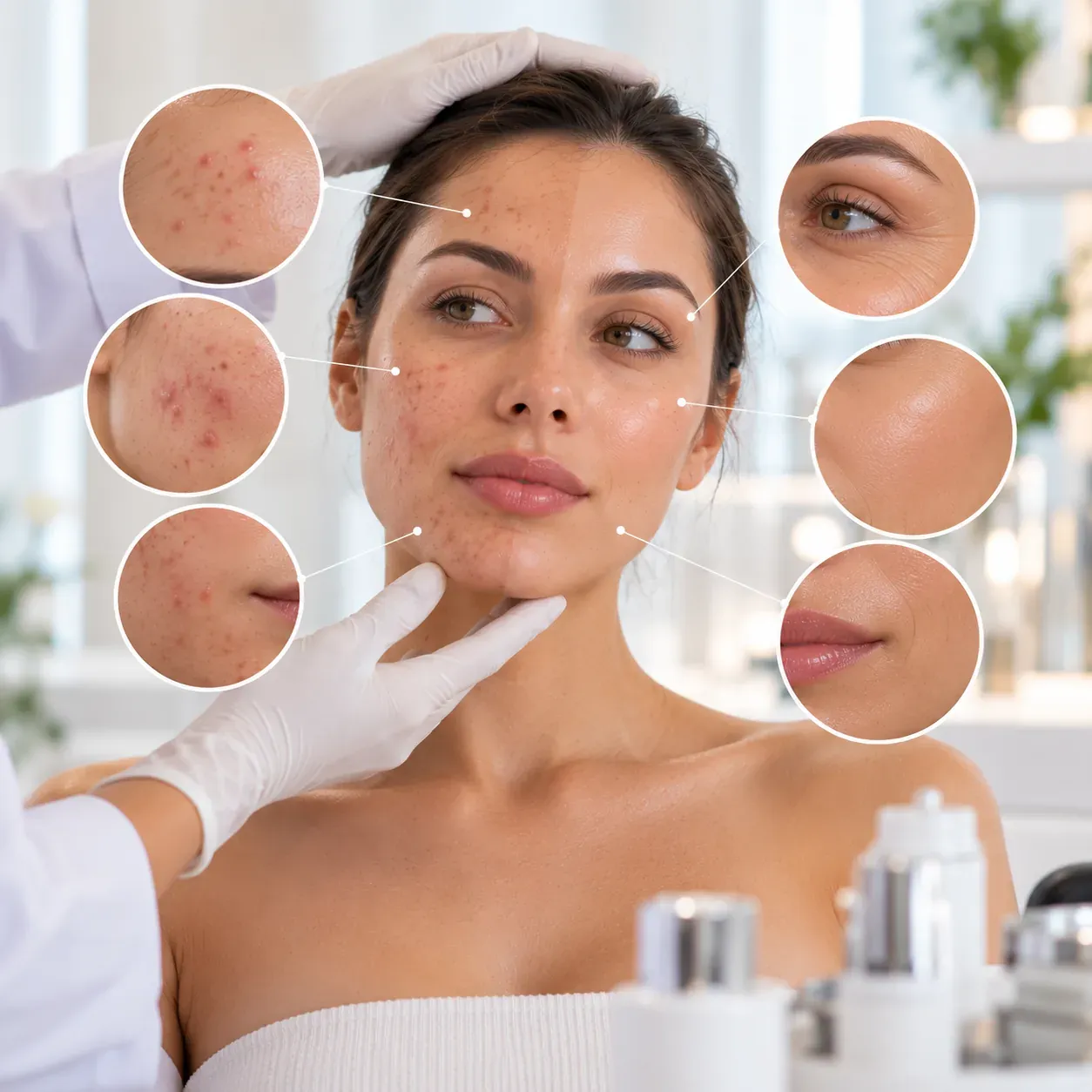
Acne is a common skin condition in which excess sebum production by the oil glands, pores clogged with dead skin cells, bacteria and inflammation all play a part. Blackheads and whiteheads (comedones) dominate in mild forms. Inflamed forms can involve red bumps and pus-filled spots, and more severe forms deep, painful nodules.
Acne care addresses the skin surface and the pores. The aims are to cleanse the skin without irritating it, to clean the pores and to maintain the moisture balance. A care session also helps to set up a home care routine suited to your skin type.
The limit of care is clear: in acne that is inflamed, widespread, nodular or prone to scarring, the doctor decides whether medication is needed. In these cases acne care does not replace treatment. If the doctor considers it appropriate, care can be planned as a supportive step that fits with the treatment.
Which signs does anti-ageing skin care target?
With age, collagen and elastin in the skin decrease, the skin's capacity to hold moisture declines and cell renewal at the surface slows down. Prolonged, unprotected sun exposure and smoking are also among the factors that influence how these changes appear.
Anti-ageing skin care is aimed at three visible aspects of these changes: fine lines, dryness and a feeling of tightness linked to moisture loss, and a dull, tired complexion. The care protocol is applied periodically. The steps and the ingredients used are determined by the specialist according to the skin assessment.
Anti-ageing skin care does not target the natural ageing process itself; the aim is regular care directed at how its signs look. Expression (dynamic) lines and volume loss are not among the targets of this care. These needs are addressed within medical aesthetics, with a doctor's assessment.
What is the difference between acne care and anti-ageing skin care?
Both usually take 45-60 minutes and require no anaesthesia; the difference lies in the skin need being addressed and in the focus of the care. The table below compares application characteristics only; it contains no outcome or superiority claims.
| Feature | Acne Care | Anti-Ageing Skin Care |
|---|---|---|
| Need addressed | Acne-prone skin: clogged pores, blackheads and whiteheads, oiliness | Appearance of signs of ageing: fine lines, loss of moisture, dull complexion |
| Focus of care | Gentle cleansing, pore cleansing, moisture balance | Moisture support and care of the skin surface; steps are set according to the skin assessment |
| Performed by | Specialist (planned with a doctor's assessment) | Specialist (planned with a doctor's assessment) |
| Role of the doctor's assessment | In inflamed or widespread acne, the doctor decides whether medication is needed | If a need goes beyond the scope of care, the doctor assesses it separately |
| Outside the scope of care | Treatment of acne with medication | Expression (dynamic) lines and volume loss |
| Duration | Usually 45-60 minutes | Usually 45-60 minutes |
| Anaesthesia | Not required | Not required |
| Frequency | Planned by the specialist according to the skin's condition | Periodic; intervals are set according to the skin assessment |
Which care may be considered for which skin need?
The choice is based on the skin's predominant need at the time and becomes clear during the skin assessment at the first consultation. For skin changes that are new, spreading quickly or painful, seeing a doctor first is recommended.
The framework below does not replace a diagnosis; it is for general information:
- If blackheads, whiteheads and oiliness predominate: acne care may be considered.
- If there are red, painful or inflamed spots, or widespread acne: a doctor's assessment comes first; the doctor decides whether medication is needed.
- If loss of moisture, dullness and fine lines predominate: anti-ageing skin care may be considered.
- If a tendency to acne and signs of ageing occur together: acne can also appear in adulthood; priority is set according to the skin's condition, and both approaches can be adapted to the skin and planned accordingly.
- If regular cleansing and moisture care is wanted without a specific concern: a classic facial, which includes cleansing, pore cleansing, a mask and moisturising, may be considered.
- If marks left after acne predominate: the type of pigmentation is determined by a doctor's assessment, and pigmentation care may be considered separately.
What is covered in the skin assessment before care?
At the first consultation, skin type, the current condition of the skin and the predominant need are assessed together. You will also be asked about any medication and skin care products you use, known allergies and recent sun exposure.
Based on this information, the specialist determines, with a doctor's assessment, which care is planned and at what intervals. If a condition beyond the scope of care is found, such as inflamed or widespread acne, the doctor carries out a separate assessment. Individual advice always takes priority over general information.
What should home care and sun protection look like?
Care at the clinic becomes meaningful together with the routine you keep up at home. For acne-prone skin and for skin showing signs of ageing alike, the common foundation is gentle cleansing, moisture and regular sun protection.
Sun protection is part of the process for both types of care: sunlight can accentuate the appearance of signs of ageing and can contribute to the darkening of marks left after acne.
- Wash your skin twice a day, morning and evening, with a gentle cleanser suited to your skin type; avoid harsh scrubbing and abrasive brushes.
- For acne-prone skin, moisturisers and make-up labelled non-comedogenic (formulated not to clog pores) can be preferred.
- Do not squeeze or pick at spots; this can increase inflammation and raise the risk of marks and scarring.
- For skin with noticeable loss of moisture, not skipping moisturiser after cleansing helps protect the skin barrier.
- Use a broad-spectrum (UVA and UVB) sunscreen with a high protection factor every day, including on cloudy days; reapply roughly every two hours when you spend long periods outdoors, and after sweating or swimming.
- Staying in the shade when the sun is strongest and wearing a wide-brimmed hat and sunglasses complete your protection.
- Before starting a new product with active ingredients, especially if you use medication for acne, consult your doctor or specialist; starting several active ingredients at the same time can irritate the skin.
Who may acne care and anti-ageing skin care not be suitable for, and what are the possible side effects?
Care may be postponed if there is an active infection, an open wound or a recent severe sunburn in the treatment area. Certain medications, particularly acne medications that can make the skin more sensitive, may affect the care plan. For this reason, any medication you use should be reported to the doctor before the session.
In inflamed, widespread or nodular acne, care alone is not an adequate approach; a doctor's assessment comes first. Known skin sensitivity or a history of allergies is also part of the suitability assessment.
Possible side effects are usually temporary: redness and sensitivity may occur after the session. If an unexpected, persistent or worsening reaction develops, the specialist and the doctor should be informed. Results vary from person to person.
Frequently asked questions
Related treatments
Related pages
This article is for general information only and is not a diagnosis or a treatment recommendation. Suitability is determined by a doctor's assessment; results vary from person to person.